


Finger clicking, stiffness, catching or locking can make everyday activities such as gripping objects, typing, writing and opening containers uncomfortable. These symptoms may be associated with trigger finger, a condition in which the tendon responsible for bending a finger does not glide smoothly through its surrounding sheath.
Trigger finger, medically known as stenosing tenosynovitis, commonly affects the ring finger, middle finger or thumb, although any digit can be involved. Some people experience intermittent clicking, while others may develop painful catching or a finger that becomes locked in a bent position.
Trigger finger treatment in Mumbai depends on the severity and duration of symptoms, the extent of movement restriction and the individual's response to treatment. Management may include activity modification, splinting, hand therapy, medication for symptom relief, corticosteroid injections or trigger finger release surgery when clinically indicated.
At a glance
At Mangal Anand Hospital in Chembur, trigger finger treatment in Mumbai is provided by our fellowship-trained hand and wrist surgeons. They examine the finger, confirm what is causing it and then recommend what it actually needs. That may be a splint, an injection or a short release procedure. Many patients never need an operation.
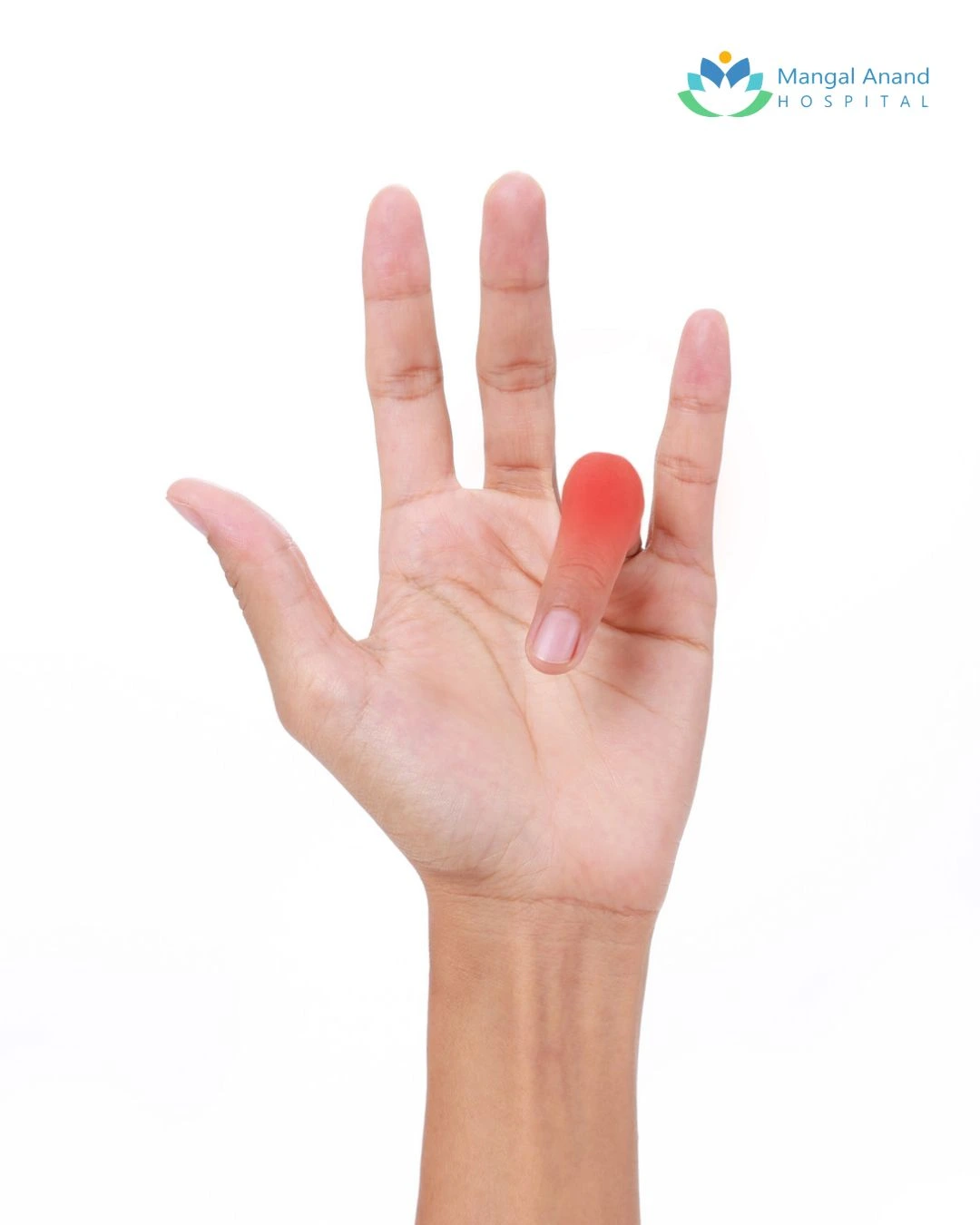
Trigger finger happens when the tendon that bends your finger cannot slide smoothly through its tunnel at the base of the finger. The medical name is stenosing tenosynovitis.
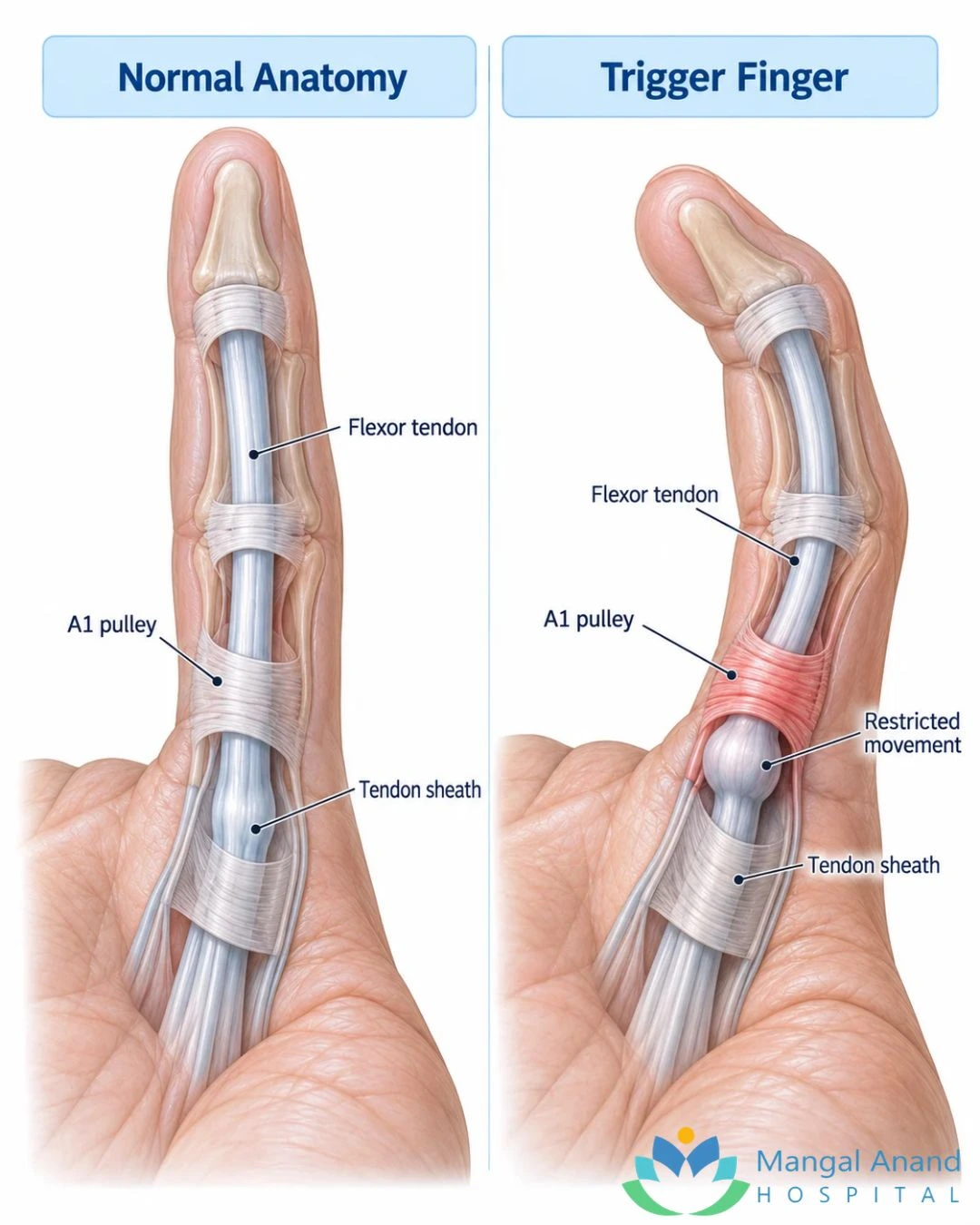
Each finger is bent by a flexor tendon. The tendon runs through a series of firm bands called pulleys, which hold it close to the bone. The first of these, the A1 pulley, sits where the finger meets the palm.
In trigger finger, the A1 pulley thickens and the tendon can swell or form a small nodule. The tendon then gets caught at the pulley's entry. When it finally pushes through, the finger snaps straight like a released trigger. That is where the condition gets its name.
The ring finger, middle finger and thumb are affected most often, but any finger can be involved. When it affects the thumb, it is called trigger thumb. The cause and treatment are largely the same.
Dr. Bipin Ghanghurde has over 12 years of specialised experience in Hand, Wrist, and Peripheral Nerve Surgery. He has received advanced fellowship training from internationally recognised centres, including Ogori Daiichi General Hospital, Japan, and University Hospital Ghent, Belgium. He also holds the prestigious European Diploma in Hand Surgery (EDHS).
His expertise includes:
He is a Life Member of the American Society for Surgery of the Hand, Indian Society for Surgery of the Hand, and the Bombay Orthopaedic Society, reflecting his continued commitment to international standards of patient care.

Dr. Kiran M. Ladkat is an experienced Orthopaedic Surgeon specialising in Hand, Wrist, Peripheral Nerve, and Microvascular Surgery. With over 12 years of clinical experience and more than 2,500 successful surgeries, he has extensive expertise in managing both routine and complex hand conditions.
He has completed advanced fellowship training at Ganga Hospital, Coimbatore, and the National University Hospital, Singapore, with a special interest in hand trauma, nerve compression disorders, congenital hand conditions, and brachial plexus injuries.
His areas of expertise include:

The usual signs are pain at the base of the finger, then clicking or catching. In later stages the finger locks in a bent position. Symptoms are often worse in the morning and ease as the hand warms up during the day.
Early signs
Later signs
Not every stiff or bent finger is trigger finger. Arthritis of the finger joints, a tendon injury and Dupuytren's contracture can look similar. Dupuytren's contracture is a painless thickening in the palm that slowly pulls fingers bent. If you also have numbness or tingling in the thumb, index and middle fingers, carpal tunnel syndrome may be present. It often occurs alongside trigger finger. A hand surgeon can usually tell these conditions apart through a careful examination. You can read more on our carpal tunnel syndrome treatment page.
The direct cause is a mismatch in size between the tendon and its A1 pulley. In most people, no single reason for that thickening can be found. Certain factors make it more likely:
Tell your surgeon if you have diabetes or thyroid disease, or if several fingers are affected. These details shape which treatment is likely to work.
Yes, often. Mild trigger finger, especially when it is recent, can settle with rest and simple treatment. Some cases improve on their own. A finger that locks often, or has been triggering for many months, is less likely to recover without treatment. Non-surgical treatment is usually tried first. Your surgeon will suggest the options that suit how severe the triggering is and how long it has been present.
Cut down on the movements that set off the click. Examples are tight gripping, wringing clothes, using hand tools or holding a phone for long periods. This reduces irritation at the pulley.
A small splint keeps the affected finger straight, usually at night, for several weeks. It stops the tendon from repeatedly catching while the swelling settles. Splinting works best for mild, early triggering. It needs to be fitted properly so it does not cause stiffness in other joints.
A hand therapist can teach gentle tendon-gliding exercises and ways to grip with less strain. They can also help with morning stiffness. Exercises support recovery but do not open a tight pulley. Hand therapy is available within the hospital.
Pain relief and anti-inflammatory tablets can ease soreness for a short time. They do not correct the catching tendon, so they are not a treatment on their own. Take them only as advised by your doctor, particularly if you have kidney, stomach or heart conditions.
A corticosteroid injection into the tendon sheath at the base of the finger reduces swelling around the tendon. It is one of the most effective non-surgical treatments. Many patients notice improvement within a few weeks. The effect can wear off and triggering may return. Injections tend to work less well in people with diabetes, when several fingers are involved, and in long-standing cases. If you have diabetes, your blood sugar may rise for a few days after an injection, so monitor it closely. Repeated injections into the same finger are avoided.
Surgery is advised when the finger keeps triggering despite non-surgical treatment. It is also advised when the finger locks often or is stuck bent. Your surgeon may suggest it earlier in some situations:
Surgery is a choice made together with you. You do not have to try every other treatment first if the finger is already locked. You also do not need surgery simply because a finger clicks.
Trigger finger release surgery opens the tight A1 pulley so the tendon can glide freely again. It is a short procedure. It is usually done under local anaesthesia, so only the hand is numbed, and most patients go home the same day.
For trigger thumb, the same release is done at the base of the thumb. The surgeon takes extra care there because a small nerve runs close to the pulley.
The local anaesthetic injection stings briefly. After that you should feel pressure or touch during the operation, but not pain. Once the anaesthetic wears off, the palm is sore for a few days. Regular pain relief and keeping the hand raised usually control this well. Tenderness over the scar when you press on it can take a few weeks to fade.
Trigger finger release is a commonly performed procedure, and serious complications are uncommon. As with any surgery, risks include:
Your surgeon will go through these risks with you, along with how your health and the duration of your symptoms affect them.
Not sure whether you need an injection or surgery? A hand surgeon can examine the finger and explain both options. Book a Trigger Finger Assessment
You can usually move the finger on the same day. Light everyday use returns within days, and stitches come out in about two weeks. Full comfort and grip strength can take a few months, especially if the finger had been locked for a long time.
Day of surgery
Go home the same day. Gently bend and straighten the fingers as advised. Keep the hand raised.
First 2 weeks
Keep the dressing clean and dry. Use the hand for light tasks such as eating, typing and dressing. Stitches are removed at the follow-up visit.
2 to 6 weeks
Return to most normal activities, including desk work and driving once you can grip the wheel safely. Palm soreness keeps easing.
6 weeks to 3 months
Heavier gripping, lifting and manual work are resumed gradually.
Up to 6 months
Any remaining swelling, scar tenderness or stiffness continues to settle.
These times are a general guide. Your surgeon will confirm a plan based on your finger and your work. People with desk jobs often return to work sooner than those whose work involves heavy gripping. If the finger stays stiff, sessions with the hospital's hand therapy team help restore movement.
Contact the hospital promptly if you notice increasing redness, swelling or discharge from the wound, fever, worsening pain, or new numbness in the finger.
The cost depends on which treatment your finger needs. Non-surgical care and a steroid injection cost considerably less than a release operation. Because every case is different, Mangal Anand Hospital gives you a written estimate after your consultation instead of a standard price.
The cost of trigger finger surgery mainly depends on:
The hospital is empanelled with major health insurers and third-party administrators. Cashless treatment is available subject to your policy terms and approval. Our insurance desk helps with pre-authorisation and documentation, and with reimbursement where cashless is not possible.
It depends on how severe the triggering is and how long it has been present. Mild, recent cases often settle with a splint, rest or a steroid injection. When the finger locks repeatedly or keeps coming back after an injection, release surgery is the most reliable long-term fix. That is because it removes the tight pulley itself.
Doctors often grade trigger finger from 1 to 4. Stage 1 is pain and tenderness at the base of the finger. Stage 2 is catching that you can still straighten yourself. Stage 3 is locking that needs the other hand to straighten it. Stage 4 means the finger is stuck in a bent position and cannot be fully straightened, even with help. Stage 4 usually needs surgical release, sometimes with hand therapy afterwards to recover movement.
There is no good evidence that a vitamin deficiency causes trigger finger. Diabetes, inflammatory arthritis and thyroid disease are linked to it, so your doctor may check for these conditions if several fingers are affected.
See a hand surgeon, or an orthopaedic surgeon with hand surgery training. They can confirm the diagnosis, rule out conditions that look similar, give an injection if needed and perform a release when it is required.
Usually not. Trigger finger is diagnosed by examining the finger and watching it move. An X-ray or ultrasound is advised only if the diagnosis is unclear, for example after an injury or when arthritis is suspected.
It is uncommon for triggering to return in a finger that has been fully released. However, trigger finger can develop in a different finger later, particularly in people with diabetes. Stiffness after surgery is a separate problem and is treated with hand therapy.
Yes, though it is different from the adult condition. In young children the thumb is usually held bent at the top joint and is rarely painful. Some cases improve with observation or splinting. Others need a small release operation. Children should be assessed by a surgeon experienced in paediatric hand conditions.
Mangal Anand Hospital is located in Chembur, Mumbai, and is conveniently accessible for patients from Ghatkopar, Kurla, Tilak Nagar, Sion, Wadala, Govandi, Deonar and Navi Mumbai.