


Highly experienced doctors
Internationally recognized team of doctors with modern equipment & services

Hip arthritis is one of the leading causes of chronic hip pain and reduced mobility in adults. As the protective cartilage inside the hip joint gradually wears away, simple activities such as walking, climbing stairs, getting out of a chair, or putting on shoes can become painful and difficult. For some people, symptoms develop slowly over several years, while others notice a more rapid decline in movement because of inflammatory arthritis, previous injuries, or underlying hip disorders.
Many people dismiss early symptoms as a normal part of ageing and continue living with pain until everyday activities become significantly affected. However, persistent hip pain is not a normal consequence of growing older. Early diagnosis and appropriate treatment can reduce pain, improve mobility, and in many cases delay or even avoid the need for surgery.
At Mangal Anand Hospital Chembur, our orthopaedic specialists evaluate the underlying cause of your symptoms before recommending treatment. Depending on the stage of arthritis and your functional needs, treatment may include physiotherapy, lifestyle modification, medication, image-guided injections, or hip replacement surgery when conservative measures are no longer effective. Our objective is to help you move comfortably, remain independent, and return to the activities that matter most to you.
Knee arthroscopy is recommended when a patient continues to have pain, swelling, or restricted knee movement despite non-surgical treatment. In many cases, imaging tests such as MRI help identify the injury, but arthroscopy allows direct visualisation of the joint and treatment during the same procedure.It is often advised for sports injuries, twisting injuries, cartilage problems, and conditions causing repeated knee locking or instability.
Successful treatment begins with an accurate diagnosis, not an immediate decision about surgery. Hip pain can arise from arthritis, avascular necrosis (AVN), bursitis, tendon disorders, spine problems, or previous injuries. Identifying the exact cause allows treatment to be tailored to the condition rather than simply managing symptoms.
At Mangal Anand Hospital, every patient undergoes a comprehensive orthopaedic assessment that combines clinical examination with appropriate imaging to understand the extent of joint damage and its impact on daily life. Treatment recommendations are individualised, taking into account the severity of arthritis, age, activity level, occupation, overall health, and long-term mobility goals.
Our philosophy is straightforward—preserve the natural hip joint whenever possible and recommend surgery only when non-surgical treatment no longer provides meaningful improvement. This patient-centred approach helps ensure that each individual receives the most appropriate treatment at the right stage of the disease.
Patients choose Mangal Anand Hospital for hip arthritis treatment because of:
Choosing the right orthopaedic specialist is an important part of successful treatment. Hip arthritis affects every patient differently, and treatment decisions should be based on careful clinical assessment rather than X-ray findings alone. Our orthopaedic team evaluates the cause of arthritis, the severity of symptoms, your lifestyle, and your long-term mobility goals before recommending the most appropriate treatment.Whether your condition can be managed conservatively or requires joint replacement surgery, you receive evidence-based care focused on improving mobility, relieving pain, and helping you return to your daily activities safely.
Qualifications
MBBS • MS (Orthopaedics) • DNB (Orthopaedics) • FCPS • FRCS
Dr. Milind Sawant is a senior orthopaedic surgeon with more than three decades of experience in joint replacement, reconstructive orthopaedics, and sports injuries. Following advanced training in India and the United Kingdom, he completed fellowships in knee surgery, sports medicine, and revision joint replacement across internationally recognised centres. Alongside his clinical practice, he has contributed to orthopaedic education and research, reflecting his commitment to evidence-based patient care.

Consultant Orthopaedic Surgeon
Qualifications
MBBS • MS (Orthopaedics) • MRCS (Edinburgh) • FRCSEd (Trauma & Orthopaedics) • Dip. CAOS
Dr. Nikhil Gokhale graduated from G.S. Medical College and KEM Hospital, Mumbai, where he received multiple distinctions and a Gold Medal in Surgery before completing his MS in Orthopaedics. He subsequently underwent advanced specialist training in the United Kingdom, including fellowships in joint replacement and reconstructive orthopaedic surgery. With experience of more than 2,500 orthopaedic procedures, he combines evidence-based practice with modern surgical techniques to deliver personalised care for patients with joint disorders.

Qualifications
MBBS • MS (Orthopaedics) • DNB (Orthopaedics)
Dr. Pradip Nemade is a Consultant Orthopaedic Surgeon with extensive experience in managing bone and joint disorders, complex trauma, and joint replacement surgery. Since 2009, he has treated patients with a wide range of orthopaedic conditions, with particular expertise in pelvic and acetabular trauma, total hip replacement, and complex orthopaedic reconstruction. His approach combines accurate diagnosis with evidence-based treatment to restore mobility, relieve pain, and improve long-term joint function.


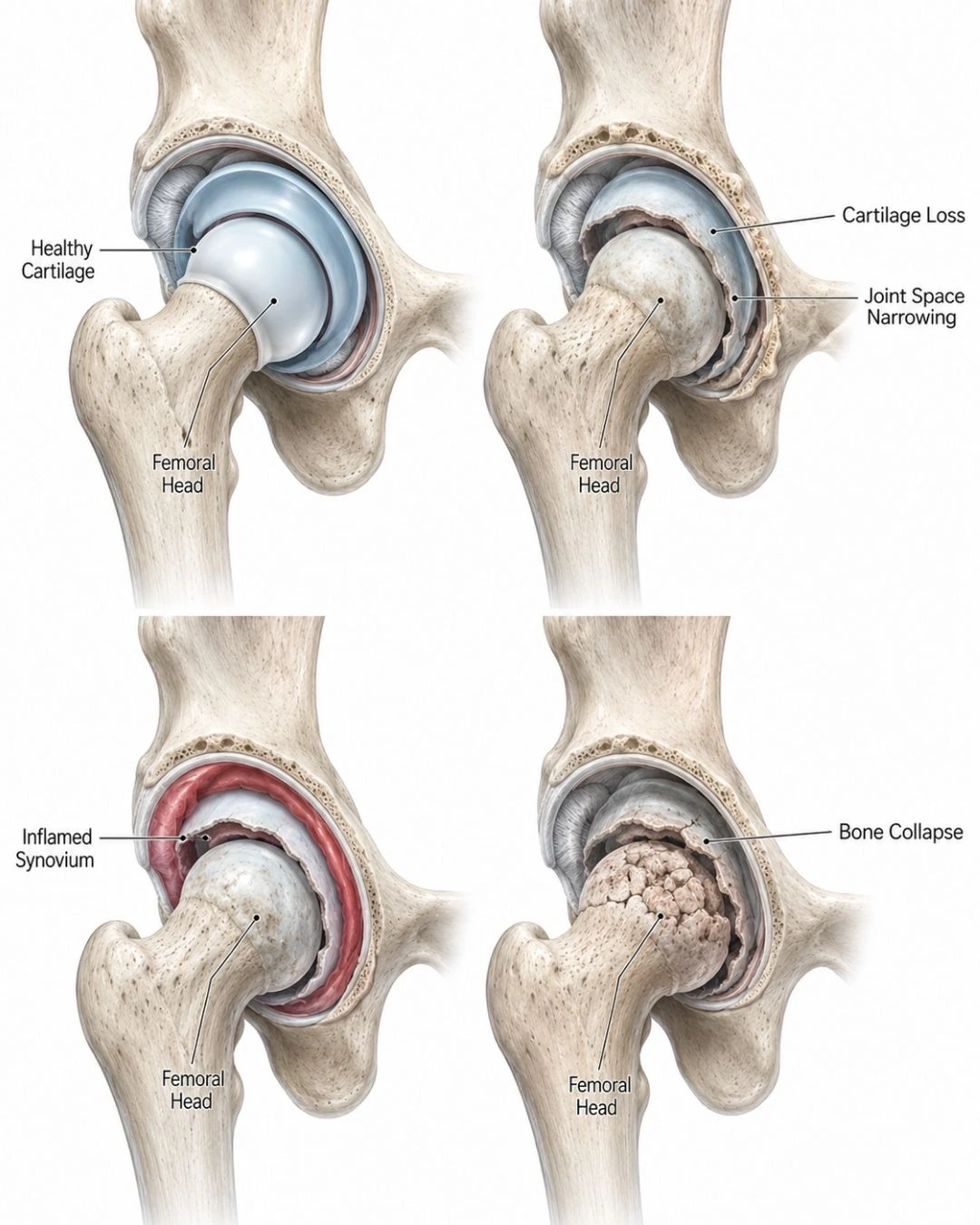
Hip arthritis is a condition in which the smooth cartilage lining the hip joint gradually becomes damaged, causing pain, stiffness, inflammation, and reduced movement. Healthy cartilage acts as a protective cushion, allowing the ball of the thigh bone (femoral head) to move smoothly within the hip socket (acetabulum) with minimal friction. When this cartilage begins to wear away or becomes damaged, movement becomes less efficient, pressure within the joint increases, and everyday activities can become progressively more painful.
One of the common misconceptions about hip arthritis is that the pain is caused by cartilage rubbing against bone. In reality, cartilage itself does not contain pain-sensitive nerves. Pain usually develops because the surrounding structures including the joint lining (synovium), underlying bone, ligaments, and surrounding muscles—become irritated as the joint gradually loses its normal mechanics. This explains why some people experience significant pain even when X-rays show only early arthritis, while others with more advanced joint damage report relatively mild symptoms.
Hip arthritis is most commonly caused by osteoarthritis, a degenerative condition associated with gradual cartilage loss. However, it may also develop because of inflammatory arthritis, previous hip injuries, developmental abnormalities of the hip, or secondary conditions such as avascular necrosis. Identifying the underlying cause is an important part of treatment because management differs depending on the type of arthritis and the stage of joint damage.
Hip arthritis is not a single disease. Several conditions can damage the hip joint and produce similar symptoms, but the underlying cause influences both treatment and long-term outcomes. Identifying the specific type of arthritis helps your orthopaedic specialist develop the most appropriate treatment plan.
Osteoarthritis is the most common type of hip arthritis and accounts for the majority of cases seen in orthopaedic practice. It develops gradually as the protective cartilage within the hip joint wears down over time. As cartilage deteriorates, the bones move less smoothly against one another, leading to pain, stiffness, reduced mobility, and progressive degeneration of the joint. Although age is an important risk factor, osteoarthritis is not an inevitable part of ageing. Previous injuries, excess body weight, genetics, developmental abnormalities of the hip, and repetitive stress on the joint may also contribute to cartilage degeneration.
Rheumatoid arthritis is an autoimmune disease in which the immune system attacks the synovial lining of the joints. Persistent inflammation damages cartilage, bone, and surrounding soft tissues, eventually affecting joint function. Unlike osteoarthritis, rheumatoid arthritis often affects multiple joints throughout the body and may involve both hips. Early diagnosis and medical management play an important role in slowing disease progression and preserving joint function.
Hip arthritis may develop months or even years after a significant injury such as a fracture or hip dislocation. Damage to the cartilage or changes in joint alignment increase the risk of premature wear, even if the original injury healed successfully. Patients with post-traumatic arthritis often have a history of previous trauma, although symptoms may not appear until long after the injury.
Avascular necrosis (AVN) occurs when the blood supply to the femoral head is reduced or interrupted. As the bone weakens and collapses, the smooth joint surface becomes damaged, eventually leading to secondary hip arthritis.Because AVN requires a different diagnostic and treatment approach, patients diagnosed with this condition should be evaluated separately.
Related Service: Avascular Necrosis (AVN) Treatment
Inflammatory conditions such as ankylosing spondylitis, psoriatic arthritis, lupus, and other autoimmune disorders can also affect the hip joint. Persistent inflammation gradually damages cartilage and surrounding tissues, causing pain, stiffness, and reduced movement.Managing inflammatory arthritis usually requires close collaboration between orthopaedic specialists and rheumatologists to control both joint damage and the underlying disease process.
No. One of the most common misconceptions about hip arthritis is that a diagnosis automatically leads to hip replacement surgery. In reality, many patients achieve significant pain relief and improved mobility through non-surgical treatment, particularly when arthritis is diagnosed in its early or moderate stages.
Treatment recommendations depend on several factors, including:
The objective is always to recommend the least invasive treatment that provides meaningful improvement. For many patients, physiotherapy, activity modification, medication, weight management, and image-guided injections may effectively control symptoms for years. Hip replacement surgery is generally considered only when these measures no longer provide adequate relief and arthritis significantly affects quality of life.This individualised approach helps ensure that treatment is appropriate for both the condition and the patient rather than being based solely on imaging findings.
No. One of the most common misconceptions about hip arthritis is that a diagnosis automatically leads to hip replacement surgery. In reality, many patients achieve significant pain relief and improved mobility through non-surgical treatment, particularly when arthritis is diagnosed in its early or moderate stages.
Treatment recommendations depend on several factors, including:
The objective is always to recommend the least invasive treatment that provides meaningful improvement. For many patients, physiotherapy, activity modification, medication, weight management, and image-guided injections may effectively control symptoms for years. Hip replacement surgery is generally considered only when these measures no longer provide adequate relief and arthritis significantly affects quality of life.This individualised approach helps ensure that treatment is appropriate for both the condition and the patient rather than being based solely on imaging findings.
Hip arthritis develops when the structures that keep the hip joint moving smoothly become damaged over time. While ageing increases the risk, it is not the only cause. Many people develop hip arthritis because of previous injuries, inflammatory joint diseases, structural abnormalities of the hip, or conditions that affect the blood supply to the joint.
Understanding the underlying cause is important because it influences treatment, expected progression, and whether joint-preserving treatment or surgery is more appropriate.
Age is the strongest risk factor for osteoarthritis of the hip. Over time, articular cartilage becomes thinner, less resilient, and less capable of repairing everyday wear. As cartilage deteriorates, the joint becomes less efficient at distributing load, increasing stress on the underlying bone.
However, age alone does not cause hip arthritis. Many older adults maintain healthy hip joints throughout life, while some younger individuals develop arthritis because of other contributing factors.
Hip fractures, dislocations, labral injuries, and severe sports injuries can permanently alter the mechanics of the hip joint. Even after the injury heals, damaged cartilage or subtle changes in joint alignment may gradually lead to arthritis years later. This is known as post-traumatic arthritis.
The hip supports a substantial proportion of the body's weight during standing, walking, climbing stairs, and other daily activities. Excess body weight increases the load transmitted through the joint, accelerating cartilage wear in susceptible individuals.Maintaining a healthy weight can reduce stress on the hip joint and may help slow disease progression.
Some people are born with structural abnormalities that increase the likelihood of arthritis later in life.
These include:
Because these conditions alter the way forces are distributed across the joint, cartilage may wear out earlier than expected.
Unlike osteoarthritis, rheumatoid arthritis is caused by an abnormal immune response that attacks the synovial lining of the joint. Persistent inflammation gradually damages cartilage, bone, and surrounding soft tissues.
Other inflammatory conditions that may affect the hip include:
These conditions often require both medical management and orthopaedic care.
Reduced blood supply to the femoral head can weaken the bone beneath the cartilage. As the bone collapses, the smooth joint surface becomes irregular, eventually leading to secondary hip arthritis.
Because AVN has a different cause, progression, and treatment pathway, it is evaluated separately from primary osteoarthritis.
Genetics influence cartilage quality, bone structure, and joint shape. People with a family history of osteoarthritis may have a greater likelihood of developing hip arthritis, although lifestyle and environmental factors also contribute.
Hip arthritis usually develops gradually, with symptoms becoming more noticeable as cartilage damage progresses. Early symptoms are often intermittent and may only occur after prolonged activity. As arthritis advances, pain and stiffness begin to interfere with everyday life.
The most common symptom of hip arthritis is pain felt deep within the groin. This occurs because the hip joint itself lies close to the groin, making it the most frequent location for arthritic pain.Pain may initially occur only after prolonged walking or exercise but can become more persistent as arthritis progresses.
One of the most confusing features of hip arthritis is that pain is not always felt in the hip.
The nerves supplying the hip also supply parts of the thigh and knee. As a result, some patients experience pain primarily around the knee despite the knee itself being completely normal.This is known as referred pain and is one of the reason why persistent knee pain sometimes requires examination of the hip joint.
Many patients notice stiffness after waking up or after sitting for prolonged periods.This happens because an arthritic joint moves less during periods of rest, allowing surrounding muscles and soft tissues to become temporarily stiff. Gentle movement usually improves symptoms within the first few minutes of activity.
As cartilage loss progresses, weight-bearing activities place increasing stress on the damaged joint.
Pain often becomes noticeable during:
Hip arthritis gradually restricts joint movement. Patients commonly find it difficult to:
Loss of flexibility usually develops gradually and may go unnoticed until everyday activities become challenging.
As pain increases, many patients unconsciously shift weight away from the affected hip while walking.
This altered gait may eventually lead to discomfort in the lower back, opposite hip, or knees because other joints compensate for the weakened hip.
Pain that begins to disturb sleep or occurs even while resting often suggests more advanced arthritis.
Night pain should not be ignored, particularly when it persists despite medication or limits normal sleep.
Many people continue living with hip pain for months or even years, assuming it is simply part of getting older. Delaying treatment, however, may allow arthritis to progress and reduce the range of non-surgical treatment options available.
You should consult an orthopaedic specialist if you experience:
An early orthopaedic assessment helps determine whether your symptoms are caused by hip arthritis or another condition such as bursitis, avascular necrosis, tendon disorders, muscle injuries, or referred pain from the lower back. An accurate diagnosis allows treatment to begin before significant joint damage occurs and provides the best opportunity to preserve long-term hip function.
There is no single treatment that works for everyone with hip arthritis. Management is individualised because the condition varies in severity, underlying cause, age of the patient, activity level, and long-term functional goals.
At Mangal Anand Hospital at Chembur, treatment follows a stepwise approach. Conservative treatment is recommended whenever appropriate, while surgical intervention is considered only when non-surgical measures no longer provide adequate relief.
Treatment may include:
The objective is to relieve pain, improve movement, preserve joint function, and help patients maintain an active and independent lifestyle.
Many patients with early and moderate hip arthritis can successfully manage their symptoms without surgery. Early intervention not only improves pain but may also help maintain mobility and delay progression of joint damage.
Physiotherapy is one of the most effective first-line treatments for hip arthritis.
A structured rehabilitation programme focuses on:
Stronger muscles provide better support to the joint, reducing stress during daily activities.
Certain activities place greater stress on the hip joint and may worsen symptoms.
Simple lifestyle changes can often reduce pain while allowing patients to remain active.
These may include:
Remaining active is generally better than prolonged rest, as inactivity may increase stiffness and muscle weakness.
Excess body weight increases the force transmitted through the hip joint with every step.
Maintaining a healthy weight can:
Even modest weight reduction may significantly improve symptoms in overweight individuals.
Medication may be prescribed to reduce pain and inflammation while allowing patients to remain active.
Depending on your condition, treatment may include:
Medication should always be taken under medical supervision, particularly in patients with kidney disease, stomach ulcers, heart disease, or other chronic medical conditions.
During painful flare-ups, temporary use of a walking stick or other assistive device may reduce pressure on the affected hip and improve walking comfort.Walking aids are usually recommended as part of a broader rehabilitation programme rather than as a permanent solution.
Some patients may benefit from image-guided corticosteroid injections into the hip joint.
These injections may temporarily reduce pain and inflammation when symptoms persist despite medication and physiotherapy or when surgery is not immediately planned. Injection therapy is recommended selectively after careful clinical assessment and is not suitable for every patient.
When non-surgical treatment no longer provides adequate pain relief, total hip replacement is the most commonly performed operation for advanced hip arthritis.
During the procedure, the damaged surfaces of the hip joint are replaced with artificial components designed to restore smooth movement and reduce pain.
The goals of surgery are to:
Every patient is assessed individually, and surgery is recommended only when the expected benefits outweigh the potential risks.
Learn more about our Hip Replacement Surgery services.
Hip arthritis is a progressive condition. Without appropriate treatment, symptoms often become more frequent and begin affecting mobility, independence, and overall quality of life.
As cartilage continues to deteriorate, patients may experience:
Reduced mobility may also contribute to weight gain, loss of fitness, and increased strain on the knees and lower back as other joints compensate for the painful hip.
Seeking treatment early provides the greatest opportunity to manage symptoms, maintain mobility, and preserve joint function before significant joint damage develops.
Not every case of hip arthritis can be prevented, particularly when genetics, inflammatory diseases, or developmental abnormalities are involved. However, several healthy lifestyle measures may help reduce the risk of joint degeneration or slow its progression.
You can help protect your hip joints by:
While these measures cannot reverse existing arthritis, they may improve joint function and reduce stress on the hip over time.
Hip arthritis cannot be reversed because damaged cartilage does not regenerate naturally. However, many patients achieve significant pain relief and improved mobility through physiotherapy, medication, lifestyle modification, weight management, and other non-surgical treatments. Surgery is considered only when conservative treatment no longer provides adequate relief.
Hip arthritis commonly causes pain in the groin, buttock, or front of the thigh, often accompanied by stiffness and reduced movement. However, similar symptoms can occur because of bursitis, tendon injuries, avascular necrosis, or problems originating from the lower back. An orthopaedic evaluation and appropriate imaging are required to determine the exact cause.
Yes. Walking is generally beneficial when performed within comfortable limits. Regular low-impact activity helps maintain joint mobility, muscle strength, and overall fitness. If walking causes significant pain, your orthopaedic specialist or physiotherapist may recommend modifying your activity or using alternative low-impact exercises.
Yes. Hip arthritis frequently causes referred pain, where discomfort is felt in the thigh or knee rather than directly in the hip. This happens because the hip and knee share some of the same nerve pathways. Persistent knee pain with a normal knee examination may require evaluation of the hip joint.
Hip replacement is considered when persistent pain, stiffness, and loss of mobility continue despite appropriate non-surgical treatment and significantly affect everyday activities or quality of life. The decision is based on your symptoms, functional limitations, and overall health rather than X-ray findings alone.
No. Although age increases the risk of osteoarthritis, persistent hip pain should never be considered a normal consequence of growing older. Many people maintain healthy hip joints throughout life, while others develop arthritis because of previous injuries, genetics, inflammatory diseases, or structural abnormalities.
Internationally recognized team of doctors with modern equipment & services

Get all your medical care under one roof with state-of-the-art facilities and equipment

Patient comfort and safety, with a clean and hygienic environment and 24/7 nursing care


