


The Achilles tendon is the thickest and strongest tendon in the body. It connects the calf muscles to the heel bone and does the work every time you take a step, climb a flight of stairs, rise onto your toes or push off to run. It also takes a beating. During running and jumping, it can carry several times your body weight.
Achilles injuries are not one condition. They run along a spectrum. At one end is a tendon that is irritated and sore after exercise. Further along is a tendon that has quietly degenerated over months or years and thickened. At the far end is a tendon that has torn partway through, or snapped completely during a sudden movement. That spectrum matters, because the treatment for each end of it is completely different. Pain at the back of the heel that has been building for six months is a different problem from a tendon that gave way during a badminton match on Sunday, even though both are called an Achilles injury. A lot of people ignore the early version. Stiffness in the first few steps out of bed gets put down to age or a long day. But an Achilles tendon that has been quietly degenerating is weaker than it looks, and a proportion of complete ruptures happen in tendons that had been mildly sore for a long time beforehand.
At Mangal Anand Hospital in Chembur, Achilles injuries are assessed by Dr. Dhrumin Sangoi, a consultant foot and ankle orthopaedic surgeon with fellowship training from the Royal National Orthopaedic Hospital, Stanmore, and Dr. Shyam Thakkar, a consultant orthopaedic and foot and ankle surgeon whose practice includes Achilles tendon rupture repair. Most Achilles injuries are treated without surgery. When surgery is needed, the type of repair is matched to the injury and to what you need to get back to.
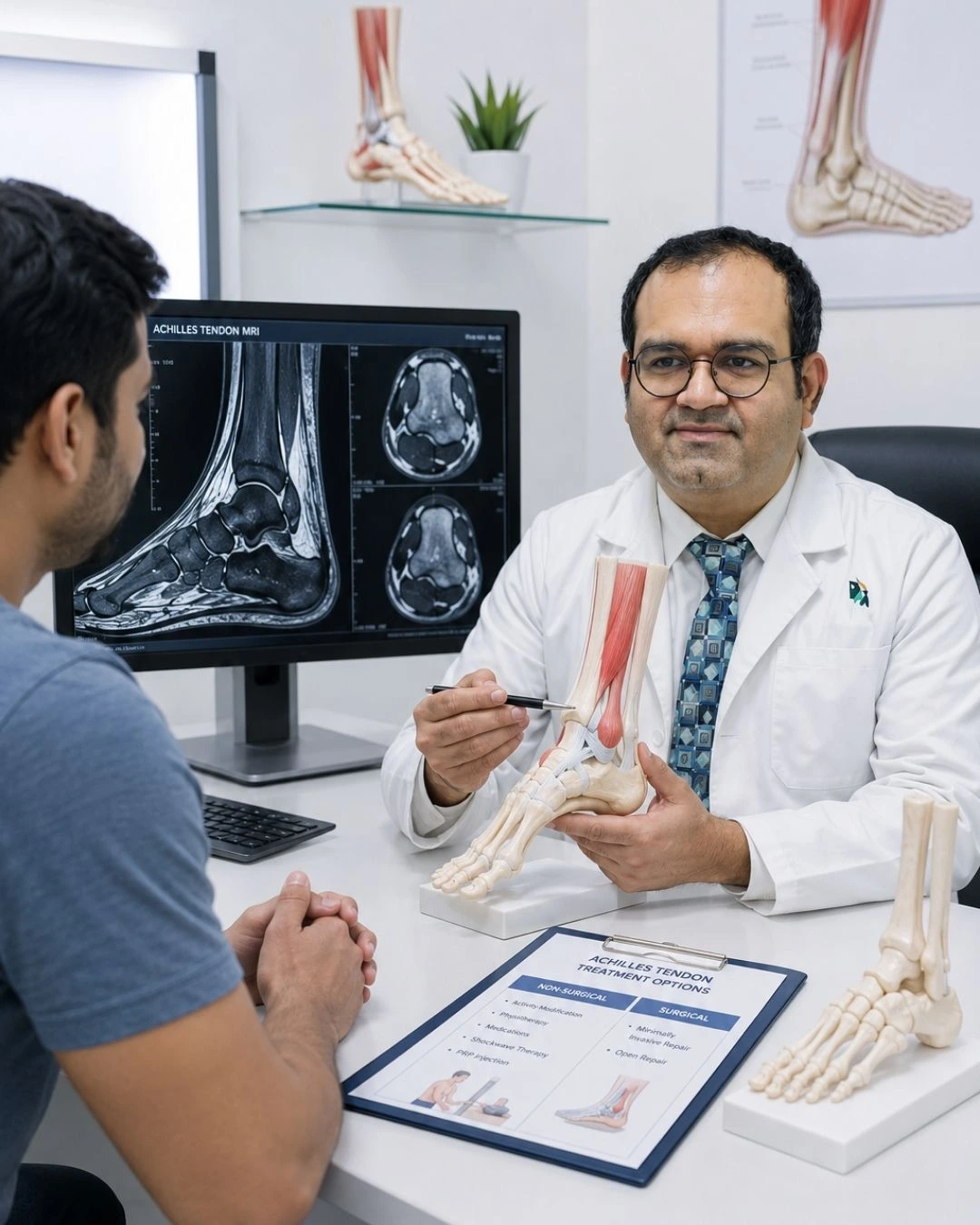
The Achilles tendon is a thick rope of collagen fibres joining the two calf muscles, the gastrocnemius and the soleus, to the back of the heel bone. When the calf muscles contract, the tendon pulls the heel upwards, which points the foot down. That single movement is what lets you push off while walking, rise onto your toes, climb stairs, jump and run. It is under load almost constantly during the day. Standing, walking on hard floors, going up a flight of stairs, squatting down. Even ordinary daily activity puts repeated tension through it.
The tendon has one particular weak spot. In the region roughly two to six centimetres above where it attaches to the heel bone, the blood supply is noticeably poorer than elsewhere. This stretch is often called the watershed zone. Tissue with a poor blood supply heals slowly, and this is exactly where most degeneration and most complete ruptures happen.
Under normal use, tiny amounts of damage occur inside the tendon and the body repairs them. Problems begin when the damage is happening faster than the repair. That imbalance is what turns a healthy tendon into a degenerated one, usually over months rather than days, and usually without dramatic symptoms along the way.
Age plays a part. Tendon tissue becomes less elastic and slower to heal from around the mid-thirties onwards, which is why the classic complete rupture happens to someone between 30 and 50 who plays sport occasionally rather than to a full-time athlete.
MBBS, Grant Medical College & Sir J.J. Hospital, Mumbai | MS Orthopaedics (Gold Medal), Goa Medical College | Foot & Ankle Fellowship, Royal National Orthopaedic Hospital, Stanmore, UK | International Fellowship in Minimally Invasive Foot & Ankle Surgery, Hospital Quirón, Barcelona
MBBS, Grant Medical College & Sir J.J. Hospital, Mumbai | MS Orthopaedics (Gold Medal), Goa Medical College | Foot & Ankle Fellowship, Royal National Orthopaedic Hospital, Stanmore, UK | International Fellowship in Minimally Invasive Foot & Ankle Surgery, Ankle Arthroscopy and Sports Injuries, Hospital Quirón, Barcelona
Dr. Dhrumin Sangoi trained for five years within the National Health Service in the United Kingdom, developing his specialisation in foot and ankle surgery and lower limb reconstruction, before completing a dedicated foot and ankle fellowship at the Royal National Orthopaedic Hospital, Stanmore, the largest orthopaedic hospital in the United Kingdom.
Achilles tendon disorders are a named part of his clinical practice, alongside heel pain and plantar fasciitis, ankle instability, sports injuries, ankle arthritis, foot deformity and complex diabetic foot problems, the last drawing on his work at King's College Hospital NHS Foundation Trust in London.
His Barcelona fellowship covered minimally invasive foot and ankle surgery, ankle arthroscopy and sports injuries, which is directly relevant to both the minimally invasive Achilles repair and the sports rehabilitation described on this page.
He has published research, presented internationally, and is a member of the British Orthopaedic Foot & Ankle Society and the Indian Foot & Ankle Society.

MBBS, Pravara Institute of Medical Sciences, 2011 | MS Orthopaedics, Maharashtra University of Health Sciences, Nashik, 2015 | 15 years of experience | Maharashtra Medical Council Registration No. 2011030609
Dr. Shyam Thakkar has specialised training in foot and ankle surgery, including minimally invasive procedures, ligament reconstruction, deformity correction and the management of sports injuries, fractures and tendon disorders.
Achilles tendon rupture repair is a specific part of his practice, as is posterior ankle arthroscopy and hindfoot endoscopy, both of which are relevant where Achilles pain sits alongside other problems at the back of the ankle. His wider foot and ankle work covers ankle arthroscopy, ankle and hindfoot fusion, flatfoot reconstruction, cavus foot, heel pain, toe deformity, and diabetic and Charcot foot.
He places weight on explaining a condition properly before treatment begins, which matters a great deal with Achilles injuries, where the result depends heavily on whether the patient understands and completes a rehabilitation programme that runs for months.

The earliest stage. Repeated stress irritates the tendon and the tissue around it, causing inflammation. It typically follows a change in activity: starting to jog, increasing training, a new job that involves more standing, or a holiday with a lot of walking. Pain sits along the tendon, is worse after activity than during it, and is often at its most obvious in the first few steps of the morning before easing off. Treated early with rest, load management and physiotherapy, most cases settle without any need for surgery.
When the irritation continues for long enough, the problem stops being inflammation and becomes structural. The neatly aligned collagen fibres are replaced by disorganised, weaker tissue. This is tendinosis, and it is a degeneration rather than an inflammation. The tendon often thickens, and you may be able to feel a firm lump along it. Pain becomes more persistent and less dependent on activity. This distinction matters, because anti inflammatory treatment works far less well here. What works is progressive loading, which is why physiotherapy rather than medication is the backbone of treatment.
A distinct problem, and one that is often missed. Here the pain is not in the middle of the tendon but right at the point where it attaches to the heel bone. There may be a bony prominence at the back of the heel, sometimes with a fluid-filled swelling over it. It behaves differently from mid-portion tendinopathy and does not respond to the same exercises. Stretching that helps a mid-tendon problem can make an insertional one worse, because it compresses the tendon against the heel bone. It is also aggravated by shoes with a stiff back edge that press directly on the painful spot.
Getting the diagnosis right between mid-portion and insertional disease changes the entire treatment plan, which is one of the practical reasons an Achilles problem is worth having properly examined rather than self-treated.
Some but not all of the tendon fibres give way. The remaining fibres keep the tendon in continuity, so function is reduced rather than lost. Typical features are a sudden sharp pain during activity, swelling over the tendon, difficulty pushing off while walking, and weakness when trying a single leg calf raise. Partial tears can be difficult to tell apart from severe tendinosis on examination alone, and imaging is often useful.
The tendon tears all the way through and the two ends separate. It nearly always happens during a sudden movement: sprinting for a ball, jumping, or pushing off hard to change direction.The description is remarkably consistent. Most people report a loud pop or snap, and a sensation of being kicked or hit in the back of the ankle, so convincingly that many turn round to see who did it. Walking becomes difficult and standing on the toes of that leg is usually impossible.
A complete rupture needs assessment quickly. Treatment decisions are more straightforward and outcomes are better when the injury is seen within the first week or two, before the torn ends begin to pull apart and scar.
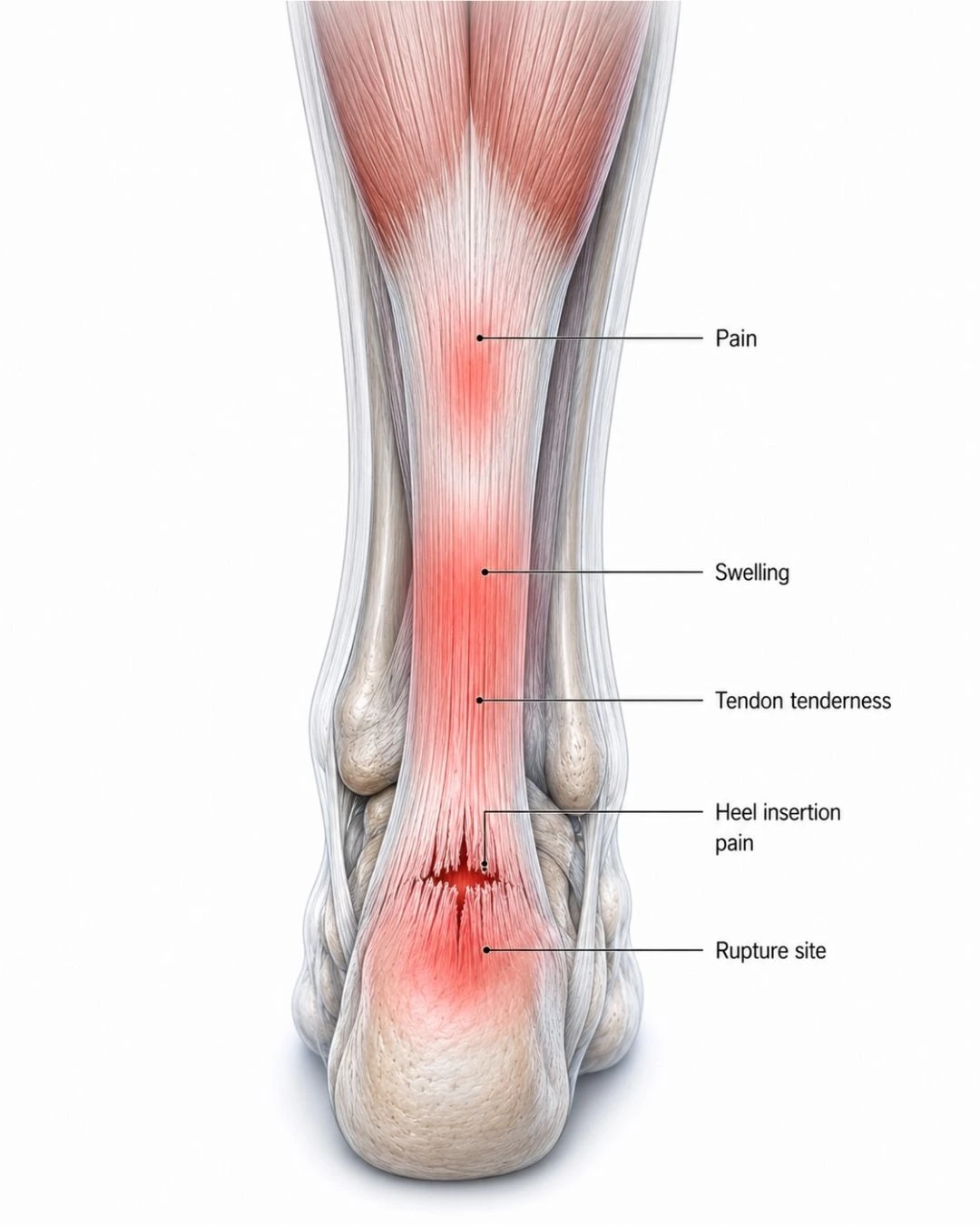
What you feel depends on where along the spectrum the injury sits.
Common symptoms include:
Two symptoms deserve urgent attention rather than a wait and see approach. A sudden pop with immediate difficulty walking, and an inability to stand on the toes of one leg, both point towards a complete rupture. Get these examined the same week rather than the same month.
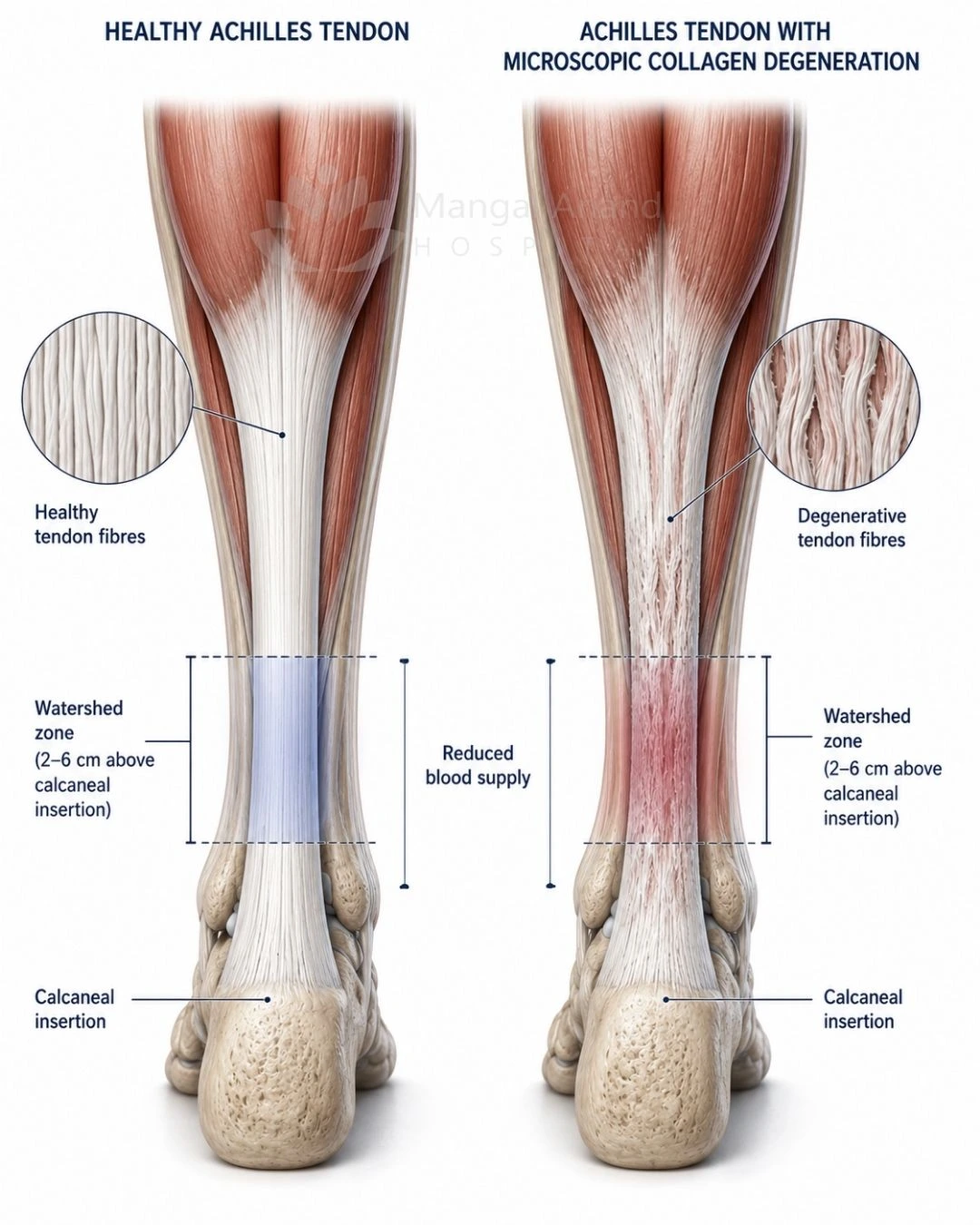
The most common route into tendinopathy. Running, jumping, stair climbing or long hours standing, done repeatedly without enough recovery, accumulates microscopic damage faster than the tendon can repair it.
Tendons adapt to load, but slowly, and much more slowly than muscle does. This is why the classic pattern is someone who has just started a new fitness routine, increased their running distance sharply, or returned to sport after months off. The muscles cope with the new load well before the tendon has caught up.
Anything with sudden acceleration, jumping or rapid changes in direction. Badminton, cricket, football, basketball, tennis and squash account for a large share of acute Achilles ruptures. Weekend sport after a sedentary week is a particular risk, because the tendon has had no preparation for what is suddenly being asked of it.
A blow to the back of the ankle, or a fall in which the foot is forced sharply upwards, can rupture the tendon outright. A misstep off a kerb or down a stair can do it.
This is the one most people do not realise. A tendon that has quietly degenerated over months is weaker than a healthy one, and can rupture during something quite ordinary. Some people who rupture had noticed nothing at all beforehand. Others had months of mild stiffness they dismissed.
Several things increase the chance of Achilles problems, either by loading the tendon more or by slowing its ability to repair.
Two of these are worth a specific word. Fluoroquinolone antibiotics carry a recognised association with tendon injury and rupture, which can occur during the course or in the weeks afterwards. If you are on one of these antibiotics and develop new tendon pain, stop the activity and contact your doctor. And steroid injections directly into or around the Achilles tendon are generally avoided for the same reason, which is why an injection that helps other tendon problems is not routinely offered here.
Having risk factors does not mean an injury will happen. It does mean that calf stretching, sensible progression in training and decent footwear are worth the effort.
Most Achilles injuries can be diagnosed accurately from the history and examination alone. Imaging is used to confirm the picture, judge severity, or plan surgery, not as a default first step.
The consultation begins with how the injury happened, whether there was a specific moment or a gradual build up, how long symptoms have been present, what makes them better or worse, and what you have already tried. Sport, occupation, previous ankle injuries, diabetes, inflammatory arthritis and any recent antibiotic course are all relevant.
On examination, the specialist works out exactly where the pain sits, since mid portion and insertional problems are treated differently. The tendon is felt along its length for thickening, a tender spot or a palpable gap. Ankle movement and calf flexibility are checked, and calf muscle bulk is compared with the other side, since a long standing problem causes visible wasting. You will be asked to walk, and if you can, to rise onto the toes of one leg. That single test tells us a great deal.
The most useful bedside test for a complete rupture, and it takes seconds.
You lie face down with your feet hanging over the end of the couch. The examiner squeezes your calf. If the tendon is intact, squeezing the calf makes the foot point downwards. If the tendon has completely ruptured, the foot barely moves.
It is a reliable test, though it is always read alongside the rest of the examination. It is also the reason a complete rupture can be diagnosed confidently in the clinic without waiting for a scan.
Usually the first scan when imaging is needed. It is quick, widely available, and it can be done dynamically, meaning the tendon is watched while the ankle is moved. It shows thickening, degeneration, partial tears, complete tears, and how far apart the torn ends sit when the foot is pointed. That last measurement can influence whether non surgical treatment is suitable.
Gives the most detail, and shows the extent of degeneration and the pattern of a tear clearly. It is used when the diagnosis is uncertain after examination, when a partial tear needs to be distinguished from severe tendinosis, when a rupture has been present for weeks or months, or when surgery is being planned.
MRI is not needed for most Achilles injuries. A straightforward complete rupture seen soon after it happened rarely requires one.
X-rays do not show the tendon. They are used to look for a bone spur at the tendon insertion, calcification within the tendon, or a fracture where the injury could have been either.
Most Achilles injuries are treated without surgery. That includes tendinitis, tendinosis, insertional tendinopathy, most partial tears, and a significant proportion of complete ruptures.
The central point, and the one patients find hardest to accept, is that tendon recovery is slow. A degenerated tendon rebuilds over months, not weeks. Rehabilitation that is followed consistently for three months beats rehabilitation that is done intensively for three weeks and then abandoned.
Not rest. Complete rest weakens a tendon further and delays recovery. What works is reducing the aggravating load while keeping the tendon working within a tolerable range. Swimming and cycling let you maintain fitness while the tendon settles.
For an acute injury, the first few days of relative rest, ice, and elevation help with pain and swelling. After that, the focus shifts to controlled loading.
A heel raise inside the shoe takes tension off the tendon and often gives quick relief. For a complete rupture treated without surgery, a walking boot with wedges holding the foot pointed down is used, with the wedges gradually removed over several weeks to bring the tendon back to length as it heals.
For insertional problems, avoid shoes with a hard, stiff back edge that presses on the painful spot. A slightly raised heel and a soft counter make a real difference.
The foundation of Achilles treatment. Structured, gradually increasing loading is what makes tendon tissue remodel and strengthen. Eccentric calf exercises, where the calf lengthens under load, are well established for mid portion tendinopathy and have good evidence behind them.
Insertional tendinopathy needs a modified programme, done without letting the heel drop below the level of the step, because that position compresses the tendon against the bone and aggravates it.
A programme also addresses calf tightness, ankle stiffness, hip and core strength, and running technique where relevant. Expect it to run for at least twelve weeks.
Anti inflammatory tablets can help short term pain in an acutely irritated tendon, where they are safe for you. They do not repair tendon tissue, and they are of limited value in tendinosis, where inflammation is not the main problem.
Steroid injections directly into the Achilles tendon are avoided, because they weaken the tendon and increase rupture risk.
For chronic tendinopathy that has not settled with several months of proper rehabilitation, shockwave therapy may be added. It is non invasive, delivered over a few sessions, and works alongside a loading programme rather than instead of one.It is not a first line treatment and it is not a shortcut past physiotherapy.
The evidence for PRP in Achilles tendinopathy is mixed. Some studies show benefit in selected patients, others show no advantage over placebo, and it has not shown consistent long term benefit across patient groups.It is presented here honestly rather than promoted. It may be discussed as an option in specific chronic cases that have not responded to a properly completed rehabilitation programme, with a clear explanation of what the evidence does and does not support.
Worth stating clearly, because many patients assume a complete rupture automatically means an operation. It does not.A ruptured Achilles can heal without surgery, provided the torn ends sit close together when the foot is pointed down, treatment starts promptly, and the patient follows a structured functional rehabilitation programme in a boot. Modern accelerated rehabilitation protocols have improved non surgical results considerably, and the gap in re-rupture rates between surgical and non surgical treatment has narrowed compared with older studies.
The trade off is that non surgical treatment avoids the risks of an operation, particularly wound problems and nerve injury, while surgical repair may offer a small advantage in re-rupture risk and in restoring calf power for high demand athletes. This is a genuine decision with reasonable arguments each way, and it is made with you rather than for you.
Surgery is considered when the tendon has ruptured and repair is the better option for that patient, when a rupture has been present long enough that the ends have pulled apart, or when chronic tendinopathy has not improved after a properly completed course of rehabilitation lasting six months or more.
The established operation for an acute complete rupture. An incision is made along the back of the ankle, the torn ends are identified and stitched together with strong sutures, and the repair is protected in a boot afterwards. It gives direct visual confirmation that the tendon ends are properly opposed and at the right tension, which matters because a tendon repaired too long stays weak. The trade off is the wound. The skin over the Achilles is thin with a modest blood supply, and wound healing problems are the most common complication of this operation, particularly in smokers and people with diabetes.
The tendon is repaired through several small incisions using a jig that passes sutures across the rupture without opening the whole area. The advantage is a substantially lower rate of wound problems, which is the main drawback of open surgery. The consideration is the sural nerve, which runs close to the tendon and can be caught by a suture, causing numbness along the outer border of the foot. Modern jig systems and careful technique have reduced this risk.
Suitability depends on the pattern of the rupture, how long ago it happened, and the quality of the tendon ends.
Where rehabilitation has genuinely been given six months or more and pain persists, surgery involves removing the degenerate tissue from within the tendon and, for insertional disease, removing the bony prominence at the back of the heel and any inflamed bursa. Where a large amount of tendon has to be removed, the tendon may need reinforcement using a nearby tendon transfer.
This is not a common operation, because the great majority of tendinopathy responds to loading if the programme is completed properly. The bar for offering it is deliberately high.
When a rupture goes undiagnosed or untreated for weeks or months, the torn ends retract and scar tissue fills the gap. The two ends can no longer simply be stitched together.
Reconstruction bridges that gap, usually by transferring a nearby tendon, most often flexor hallucis longus, to restore power. It is a bigger operation with a longer recovery than an acute repair, which is the practical reason to have a suspected rupture assessed within days rather than months.
- A complete rupture where the ends do not come together adequately in a boot
- A rupture that has been present for several weeks with retraction of the ends
- A re-rupture after previous non surgical treatment
- High demand athletes and physically demanding occupations, after discussion of the trade offs
- Chronic tendinopathy that has failed a properly completed six month rehabilitation programme
- Large partial tears with significant loss of function
Surgery is generally avoided where wound healing is likely to be a problem: poorly controlled diabetes, peripheral vascular disease, active smoking, or fragile skin over the tendon. It is also inappropriate where rehabilitation has not genuinely been tried, which is the most common reason a patient asking about Achilles surgery is advised against it.
If you smoke, stopping before and after surgery makes a real difference to wound healing and tendon repair. It is the single most useful thing you can do to improve your own result.
Achilles recovery is longer than most people expect, and this applies whether or not you have surgery. Tendon heals slowly, and the calf muscle takes months to rebuild the strength it loses while immobilised.
The timeline below is a general guide for a complete rupture, treated surgically or non surgically. Tendinopathy managed with physiotherapy follows a different and usually less restricted path, though it is not necessarily quicker.
The ankle is held in a boot or cast with the foot pointed downwards, which keeps the tendon ends close together. Weight bearing depends on your treatment and your surgeon's instruction.
Keep the leg elevated as much as possible. Swelling is a large part of early discomfort. If you have had surgery, the dressing must stay dry and the wound is checked at around two weeks when sutures come out. Report increasing redness, discharge or fever rather than waiting.
Most patients are prescribed something to reduce the risk of a blood clot in the leg during this immobilised period.
The boot stays on, but the wedges under the heel are removed gradually, bringing the foot back towards a neutral position over several weeks. This progressively lengthens the healing tendon in a controlled way.
Weight bearing usually increases during this period. Gentle movement of the ankle within a protected range often begins, along with exercises for the hip, knee and the other leg. Wasting of the calf becomes noticeable, which is expected.
The boot usually comes off somewhere in this window and you move into a normal shoe, often with a temporary heel raise that is reduced over a few weeks.
Physiotherapy steps up. Walking pattern is retrained, range of movement is restored, and calf strengthening begins in earnest. Most people walk without aids during this period. Do not attempt a single leg calf raise until your physiotherapist introduces it, and expect it to be impossible at first.
Strength work is the main task. The calf rebuilds slowly and this is the stage that determines your eventual power. Skipping it is the most common reason people are dissatisfied with the result a year later.
Straight line jogging is often introduced towards the end of this period, subject to strength testing rather than to the calendar. Cycling and swimming continue throughout.
Return to sport happens here, not earlier, and it is staged. Running before cutting, cutting before jumping, training before competition. Calf strength on the injured side is compared with the other leg, and a meaningful difference usually means more strength work before progressing.
Most people are back to full activity between six and twelve months. Some residual difference in calf size and power can persist, particularly after a rupture, and this is common rather than a sign that something went wrong.
For the first two weeks the ankle is immobilised in a boot with the foot pointed down and the leg kept elevated. Between two and six weeks the boot stays on while the heel wedges are gradually removed and weight bearing increases. Somewhere between six and twelve weeks the boot comes off, walking normalises and calf strengthening begins. From three to six months the focus is rebuilding calf strength, with jogging introduced towards the end if strength allows. Between six and twelve months you progress back through running, cutting and jumping to full sport.
Work: Desk based work is often possible within two to three weeks, provided you can get there safely in a boot and keep the leg elevated for part of the day. Jobs involving standing, walking, climbing or manual work generally need three months or more. Tell your surgeon what your day actually involves, including your commute, since navigating a crowded train or bus in a boot is a genuine consideration in Mumbai.
Driving: Not while in a boot on the right leg. You need to be out of the boot, able to brake hard without hesitation, and off any medication affecting alertness. Left leg injuries in an automatic allow an earlier return. Check your motor insurance position as well as your surgeon's opinion.
Sport: Staged and strength led rather than time led. Swimming and stationary cycling come first, then straight line jogging, then changes of direction, then jumping, then competitive play. Badminton, cricket, football and squash all involve exactly the movements that caused the injury, so these come last.
Daily life at home: Two practical points. Squatting and sitting cross legged both put the ankle into a position that a healing Achilles will not tolerate early on, so expect to need a chair for several weeks and to return to floor sitting gradually. And stairs are harder than flat ground with an Achilles injury, so take them one at a time, leading with the good leg going up and the injured leg going down.
Re-rupture : The most significant risk, whether treated surgically or not. It is most likely in the first few months while the tendon is still remodelling, and usually happens when someone returns to activity too early or misjudges a step. Following the rehabilitation timetable is the main protection.
Wound healing problems: The most common complication of open repair. The skin over the Achilles is thin with a limited blood supply. Smoking and diabetes both raise the risk considerably.
Sural nerve injury: Numbness along the outer edge of the foot, most relevant to percutaneous repair where the nerve can be caught in a suture. Usually settles, occasionally permanent.
Blood clots: Immobilisation in a boot raises the risk of deep vein thrombosis. Preventive treatment is usually prescribed. Report new calf swelling in the other leg, or breathlessness, urgently.
Persistent calf weakness: Common to some degree after a complete rupture. The gap narrows with sustained strength work but a small difference between sides can remain.
Stiffness and reduced ankle movement: Usually improves with physiotherapy.
Infection: Uncommon, but the consequences over a tendon repair are serious, so early reporting matters.
Ongoing pain despite treatment: A minority of chronic tendinopathy does not fully settle even with proper rehabilitation and, where appropriate, surgery. This is discussed honestly before any operation rather than afterwards.
Not every injury is avoidable, but a good number are.
The most useful single change for the occasional sportsperson is doing some calf strength work during the week rather than only loading the tendon heavily on a Sunday.
Achilles tendon repair, reconstruction and surgery for chronic tendinopathy are medically necessary orthopaedic procedures and are covered by most health insurance policies and corporate group plans.
Mangal Anand Hospital works with a wide range of insurers and third party administrators, and cashless treatment is available under most empanelled policies. The insurance desk handles pre-authorisation with you. Acute ruptures are usually emergency or urgent admissions, and in these cases the insurance desk can begin authorisation after admission rather than before. Bring your policy details and photo ID with you if you can. For planned surgery, such as chronic tendinopathy or a reconstruction, pre-authorisation is arranged in advance and typically takes a couple of working days, so factor that in before fixing a date.
A few things worth knowing. Check whether your policy has a waiting period for orthopaedic procedures if it was issued recently. Keep records of the non-surgical treatment and physiotherapy you have already had, since insurers frequently ask for evidence that conservative treatment was tried before approving surgery for a chronic problem. Ask specifically whether your plan covers post-operative physiotherapy, since Achilles rehabilitation runs for several months and cover for it varies considerably between policies. And confirm room category and implant cover before admission, as these are the two items most likely to leave a balance at discharge.
Achilles injuries are easy to treat badly. A mid-portion tendinopathy given insertional exercises gets worse. A rupture missed in a busy casualty and called a sprain becomes a neglected rupture needing reconstruction six months later. A rehabilitation programme abandoned at eight weeks leaves a permanently weak calf.
Assessment here starts with working out precisely which Achilles problem you have and where along the tendon it sits, because that single distinction drives everything that follows. Ultrasound and MRI are available where they will change the plan, and are not ordered where they will not.
Most patients are treated without surgery, and the rehabilitation programme is treated as the actual treatment rather than as aftercare. Where surgery is needed, the choice between open and minimally invasive repair is made on the pattern of the injury, the state of the tendon and your own risk factors for wound healing, not on preference.
Alongside Achilles problems, the foot and ankle service treats heel pain and plantar fasciitis, ankle instability and ligament injuries, ankle arthroscopy, sports injuries of the foot and ankle, flatfoot and cavus foot, bunions and forefoot deformity, diabetic and Charcot foot, and foot and ankle fractures. Achilles problems frequently sit alongside calf tightness, flatfoot or a previous ankle injury, and treating the whole picture is what stops the problem recurring.
Being part of an orthopaedic department in Chembur means imaging, physiotherapy, the insurance desk and your surgeon are all in one place. That matters more with an Achilles injury than with most conditions, because you will be coming back regularly for several months rather than once or twice. Patients travel to us from across eastern Mumbai and from Navi Mumbai, and having the scan, the consultation and the physiotherapy session in one visit rather than three is the difference between a rehabilitation programme that gets completed and one that quietly gets abandoned around week six.
Mangal Anand Hospital is located in Chembur, Mumbai, and is conveniently accessible for patients from Ghatkopar, Kurla, Tilak Nagar, Sion, Wadala, Govandi, Deonar and Navi Mumbai.
Pain, swelling or weakness at the back of the ankle is worth having examined rather than working around. Early Achilles problems respond well to the right treatment, and the same problem left for a year is harder to treat and slower to recover.
If you heard a pop and cannot rise onto your toes, do not wait. A rupture seen within the first week or two has more treatment options and a more straightforward recovery than the same injury seen three months later, when reconstruction may be the only option left.
A consultation at Mangal Anand Hospital includes a full examination of the tendon and ankle, an assessment of your walking and calf strength, and imaging where it will change the plan. You will get a clear explanation of which Achilles problem you have, what the treatment involves, and how long recovery will realistically take.
To book an appointment with our foot and ankle specialists at Mangal Anand Hospital, Chembur, contact the hospital directly or use the appointment form on this page. We see patients from across eastern Mumbai and Navi Mumbai.
If you have previous X-rays, ultrasound or MRI reports, bring them with you, along with details of any physiotherapy you have already had and any antibiotics you have taken recently.
How long does an Achilles tendon injury take to heal?
Tendinitis often settles in six to twelve weeks with the right treatment. Chronic tendinosis usually needs at least three months of consistent loading work and sometimes longer. A complete rupture, whether repaired surgically or not, takes six to twelve months for full return to sport, though normal walking comes back much earlier.
Yes, in many cases. A complete rupture can heal without surgery if the torn ends sit close together when the foot is pointed down, treatment starts promptly, and you follow a structured programme in a boot. Non surgical treatment avoids the risks of an operation, while surgical repair may offer a small advantage in re-rupture risk and in calf power for high demand athletes. Which suits you is a decision made together after examination and, usually, an ultrasound.
The pattern is usually distinctive. A complete rupture involves a sudden pop or the feeling of being kicked in the back of the ankle, immediate difficulty walking, and an inability to stand on the toes of that leg. A strain or tendinopathy builds gradually, hurts more in the morning, and still allows a calf raise even if it is uncomfortable. If you cannot rise onto the toes of one leg, get it examined that week.
The first few days are uncomfortable and managed with medication, elevation and ice. Most patients find pain settles within one to two weeks. The harder part of the recovery is usually the length of the rehabilitation rather than the pain.
Typically six to eight weeks for a complete rupture, with the heel wedges gradually removed during that time so the foot comes back to neutral. Tendinopathy treated without surgery may need a boot for a shorter period or not at all.
You will usually be weight bearing in a boot within the first few weeks. Walking without the boot generally starts somewhere between six and twelve weeks, often with a temporary heel raise inside the shoe that is reduced over a few weeks. Walking with a normal pattern rather than a limp takes a little longer and is something physiotherapy works on.
Mostly. Calf muscle wastes noticeably during immobilisation and rebuilds slowly with strength work. Most people regain good function, though a small difference in calf size and power compared with the other leg is common after a complete rupture and does not usually affect daily activity.
Re-rupture is the main risk and is highest in the first few months while the tendon is still remodelling. Completing rehabilitation and returning to sport in stages rather than all at once is the main protection. Having had one Achilles injury also somewhat raises the risk on the other side, so calf strengthening is worth continuing long term.
Often not. A straightforward complete rupture seen soon after it happened can usually be diagnosed on examination, with ultrasound to confirm. MRI is used when the diagnosis is unclear, when a partial tear needs distinguishing from severe degeneration, when the injury is weeks or months old, or when surgery is being planned.
The evidence is mixed. Some studies show benefit in selected patients, others show no advantage over placebo, and consistent long term benefit has not been demonstrated. It is not a substitute for a loading programme. It may be discussed for specific chronic cases that have not responded to properly completed rehabilitation.
Steroid injected into or around the Achilles tendon weakens it and increases the risk of rupture. This is why an injection that is used for some other tendon problems is not routinely offered for the Achilles.
Fluoroquinolone antibiotics such as ciprofloxacin and levofloxacin carry a recognised association with tendon injury and rupture, which can occur during the course or in the weeks after it. If you develop new tendon pain while taking one, stop the aggravating activity and contact your doctor.
Usually between six and twelve months, and progressed in stages rather than all at once. Both sports involve exactly the sudden acceleration and direction change that cause Achilles ruptures, so they come at the end of the rehabilitation ladder, after jogging and after change of direction work, and after your strength on the injured side has been tested against the other leg.
Results are generally good. Most patients regain the ability to walk normally, return to work and get back to recreational activity. Re-rupture after surgical repair is uncommon. What varies more is the final calf power, and that depends less on the operation than on whether the strength work in months three to six is completed properly. Outcomes are better for injuries treated within the first couple of weeks than for ruptures that have been left for months.
For mid portion tendinopathy, progressive eccentric calf loading is the mainstay, done off a step so the heel drops below the toes, performed daily and continued for at least twelve weeks. For insertional problems the same exercise is done on flat ground without letting the heel drop, because dropping it compresses the tendon against the heel bone and makes things worse.
After a rupture, exercises are staged: ankle movement first, then double leg calf raises, then single leg, then hopping and running drills much later. Which stage you are at should be decided by your physiotherapist based on what you can actually do, not by the calendar. This is the one condition where doing the exercises yourself from a video is genuinely likely to set you back.
Many can. The most useful measures are increasing training load gradually rather than in jumps, keeping the calf muscles strong and flexible during the week rather than only loading the tendon on a Sunday, warming up before sport, replacing worn out shoes, and building back slowly after any break from activity. Treating early Achilles pain rather than playing through it prevents a good number of the ruptures we see.
Book an assessment for heel or tendon pain that has lasted more than a few weeks, pain that is getting worse despite rest, swelling or thickening you can feel along the tendon, or weakness pushing off. See someone urgently if you heard a pop, cannot walk properly, or cannot stand on the toes of one leg.