


Numbness, tingling, pain or weakness in your hand should not be ignored. These symptoms are often caused by carpal tunnel syndrome, a condition in which the median nerve becomes compressed at the wrist. Left untreated, it can gradually erode hand strength, dexterity and your ability to get through an ordinary day.
At Mangal Anand Hospital in Chembur, Mumbai, carpal tunnel syndrome is managed by fellowship-trained Hand & Wrist Surgeons with advanced training in hand surgery, microsurgery and peripheral nerve surgery. Treatment ranges from splinting and injections through to open and endoscopic carpal tunnel release, matched to the severity of your condition rather than applied by default. Whether your symptoms are mild or have started interfering with your work, your sleep or your grip, early treatment relieves pain, protects the nerve and restores function.
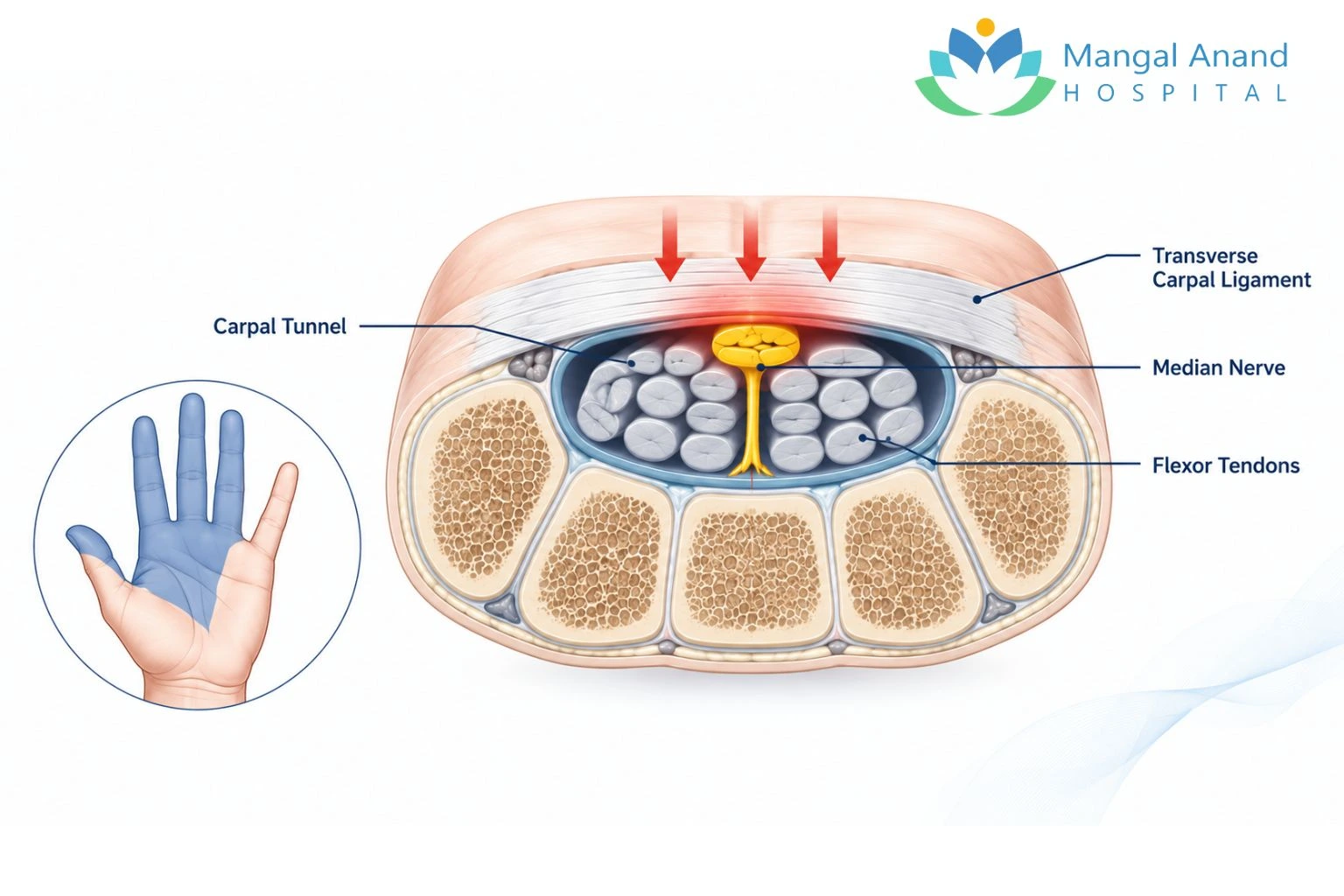
Carpal tunnel syndrome is the most common nerve compression disorder of the upper limb. It develops when the median nerve — which carries sensation to the thumb, index finger, middle finger and half of the ring finger — is squeezed as it passes through a narrow channel in the wrist called the carpal tunnel.
The tunnel is bounded by the wrist bones on three sides and by a tough band of tissue, the transverse carpal ligament, across the top. It is a fixed space. When the tissues surrounding the tendons that share this tunnel become swollen, pressure inside it rises, and the nerve is the structure that suffers.
That pressure produces tingling, numbness, burning pain and weakness. Most people first notice it while holding a phone, typing, driving or reading — or at night, when the wrist naturally curls during sleep. As compression progresses, buttoning a shirt, holding a cup or gripping a steering wheel becomes steadily harder.
Diagnosed early, the condition responds well to non-surgical treatment. Diagnosed late, some of the nerve damage may be permanent.
Dr. Bipin Ghanghurde has over 12 years of specialised experience in Hand, Wrist, and Peripheral Nerve Surgery. He has received advanced fellowship training from internationally recognised centres, including Ogori Daiichi General Hospital, Japan, and University Hospital Ghent, Belgium. He also holds the prestigious European Diploma in Hand Surgery (EDHS).
His expertise includes:
He is a Life Member of the American Society for Surgery of the Hand, Indian Society for Surgery of the Hand, and the Bombay Orthopaedic Society, reflecting his continued commitment to international standards of patient care.

Dr. Kiran M. Ladkat is an experienced Orthopaedic Surgeon specialising in Hand, Wrist, Peripheral Nerve, and Microvascular Surgery. With over 12 years of clinical experience and more than 2,500 successful surgeries, he has extensive expertise in managing both routine and complex hand conditions.
He has completed advanced fellowship training at Ganga Hospital, Coimbatore, and the National University Hospital, Singapore, with a special interest in hand trauma, nerve compression disorders, congenital hand conditions, and brachial plexus injuries.
His areas of expertise include:

Symptoms usually develop gradually and worsen in a recognisable pattern.
In the early stage, symptoms come and go, and many people dismiss them as ordinary wrist strain. You may notice a pins-and-needles sensation in the thumb, index, middle and part of the ring finger. Numbness appears intermittently. Symptoms are typically worse at night, and shaking the hand out often brings temporary relief. Mild wrist ache after prolonged hand use is common.
As compression increases, the symptoms stop resolving on their own:
Prolonged pressure on the median nerve eventually causes structural damage. At this stage, you may see visible wasting of the muscles at the base of the thumb, persistent loss of sensation that no longer fluctuates, and difficulty with fine movements such as picking up small objects or fastening buttons.
Advanced symptoms indicate established nerve injury. Treatment at this point aims to prevent further deterioration.
Most people wait too long. The early symptoms are mild and intermittent, which makes them easy to attribute to overuse.Book an assessment with a Hand & Wrist Specialist if you have tingling or numbness lasting more than a few weeks, night-time symptoms that wake you, weakness when gripping, frequent dropping of objects, pain that interferes with work, or symptoms that persist despite rest.
The distinction that matters is not how painful the symptoms are, but how long the nerve has been under pressure. Patients seen early are frequently managed without surgery. Patients seen after muscle wasting has begun have fewer options and less predictable outcomes.
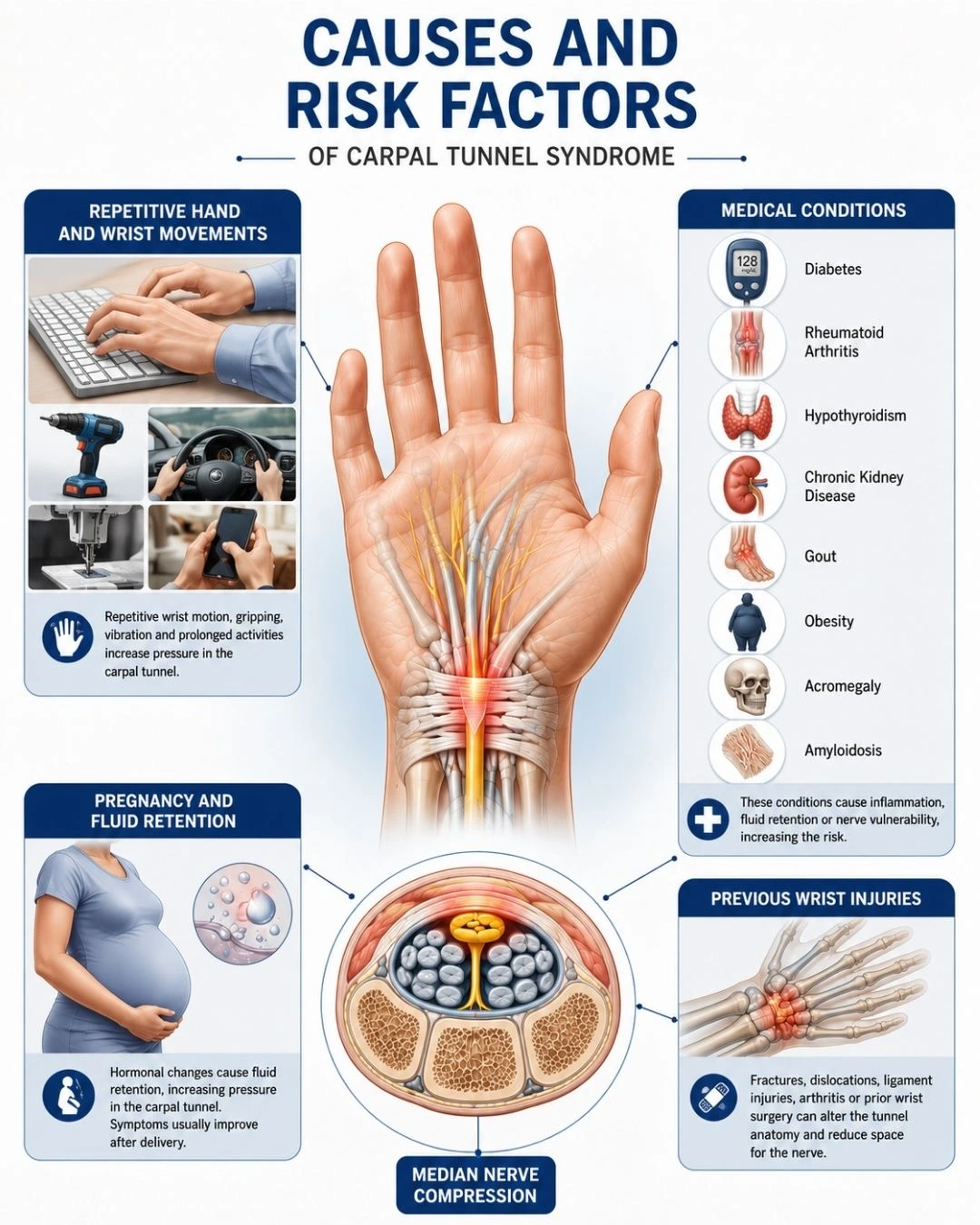
Carpal tunnel syndrome rarely has a single cause. In most patients, it results from a combination of repetitive hand use, an underlying medical condition, and the individual dimensions of their own wrist.
Activities involving repeated wrist flexion, sustained gripping or vibration irritate the tissue around the tendons, raising pressure inside the tunnel. This is common among people who work long hours at a keyboard, operate vibrating tools or hand-held machinery, perform assembly-line work, drive for extended periods, sew or do repetitive craft work, or play a musical instrument regularly. Repetitive activity alone does not usually cause the condition. It aggravates symptoms in people already predisposed to it.
Several conditions raise risk by causing inflammation, fluid retention or nerve vulnerability: diabetes, rheumatoid arthritis, hypothyroidism, gout, obesity, chronic kidney disease, acromegaly and amyloidosis.
Diabetes deserves particular mention. Long-standing diabetes affects nerve health directly, making the median nerve more susceptible to compression and slower to recover afterwards. Controlling the underlying condition improves treatment outcomes.
Hormonal changes in pregnancy increase fluid retention, which raises pressure inside the carpal tunnel. Many women develop numbness or tingling during the second and third trimesters. Symptoms usually settle after delivery, but severe or persistent symptoms should still be assessed.
A fracture, dislocation, ligament injury, post-traumatic arthritis or previous wrist surgery can alter the shape of the tunnel and reduce the space available to the nerve. This may produce symptoms months or years after the original injury.
The condition is more common in women, partly because the carpal tunnel is anatomically smaller. It is most frequently diagnosed between the ages of 40 and 60. Some people are simply born with a narrower tunnel, which cannot be changed but can be effectively managed.
Occupationally, higher rates are seen among computer and office workers, factory workers, mechanics, electricians, dentists, surgeons, tailors, beauticians, hairdressers, cashiers, musicians and drivers.
Not all hand numbness is carpal tunnel syndrome. Several conditions produce overlapping symptoms, and treating the wrong one wastes months. This is the main reason a specialist assessment is worth more than a self-diagnosis.
A compressed nerve root in the neck can send pain, numbness or tingling down into the shoulder, arm and hand. The distinguishing feature is associated neck pain or stiffness, and symptoms that follow a different distribution from the median nerve.
Here the ulnar nerve is compressed at the elbow rather than the median nerve at the wrist. Symptoms affect the little finger and the adjacent half of the ring finger which is the opposite pattern to carpal tunnel syndrome often with weakness of grip and pinch.
Commonly associated with diabetes, peripheral neuropathy affects multiple nerves at once. It typically involves both hands and both feet, with burning or reduced sensation that does not respect the median nerve's territory.
Trigger finger and De Quervain's tenosynovitis cause pain and catching around the hand and wrist, but they do not produce true numbness, because no nerve is compressed.
Osteoarthritis and inflammatory arthritis cause wrist pain, swelling and restricted movement. They can also coexist with carpal tunnel syndrome, which is why examination findings matter more than symptoms alone.
Examination assesses sensation, thumb and grip strength, finger movement, wrist mobility and areas of tenderness, and looks for thumb muscle wasting. Three provocative tests support the diagnosis.
Phalen's test. The wrists are held flexed for about a minute. Reproduction of tingling in the median nerve distribution is a positive result.
Tinel's sign. The median nerve is gently tapped at the wrist. Tingling radiating into the fingers suggests nerve irritation.
Durkan's compression test. Direct pressure is applied over the carpal tunnel. This is often the most reliable of the three, particularly in earlier cases.
A nerve conduction study measures how fast electrical signals travel along the median nerve. It confirms the diagnosis, grades the severity of compression, and guides whether surgery is appropriate.Electromyography assesses the electrical activity of the muscles the nerve supplies. It is particularly useful when symptoms are severe, when weakness is present, or when another nerve disorder is suspected. Together, these tests convert a clinical impression into an objective measurement — which is why treatment decisions at Mangal Anand Hospital are based on the degree of nerve compression, not on symptoms alone.
Imaging is not needed for every patient. X-rays may be requested to identify fracture or arthritis, ultrasound to assess the nerve and surrounding soft tissue, and MRI where a complex wrist problem or an unusual cause of compression is suspected.
Most patients with mild to moderate carpal tunnel syndrome improve without surgery, particularly when the condition is caught early. The aim is to reduce pressure on the nerve, relieve symptoms and halt progression.
Small changes to how you use your hands make a measurable difference. Reduce repetitive wrist flexion, break up long spells of hand-intensive work, avoid sustained forceful gripping, and keep the wrist in a neutral position while typing. An ergonomic keyboard and a properly set-up workstation help considerably. The same measures reduce the chance of symptoms returning after treatment, which is why they are worth establishing as habits rather than treating as a temporary fix. Managing diabetes and thyroid disorders and maintaining a healthy weight also lower risk. During a flare-up, rest the hand and apply a cold pack for short periods.
A splint holds the wrist neutral and prevents the unconscious flexion that raises pressure during sleep. Night splinting is particularly effective for patients who wake with numbness, and many notice steady improvement over several weeks of consistent use. Splints are also useful during repetitive tasks and symptom flare-ups.
Anti-inflammatory and pain-relief medication reduces discomfort but does not remove the compression causing it. Medication is a supporting measure, used alongside splinting and activity modification rather than instead of them. Prolonged self-medication without review is not advisable.
Where symptoms persist despite initial conservative treatment, a corticosteroid injection can reduce inflammation and swelling within the tunnel, easing pain and numbness and in some patients deferring or avoiding surgery. The duration of relief varies considerably between individuals. An injection is a valuable diagnostic and therapeutic tool, but it is not a durable solution for significant nerve compression.
Structured therapy reduces pain, restores wrist mobility and rebuilds grip strength through stretching, range-of-motion work, soft tissue mobilisation and graded strengthening. Hand therapy adds a functional layer — improving coordination, teaching joint protection, and adapting the specific daily and occupational tasks that provoke your symptoms. This is especially valuable for patients whose work involves repetitive hand use.
Median nerve gliding and tendon gliding exercises can improve tendon movement and reduce stiffness in patients with mild symptoms. Gentle wrist stretching and finger mobility work are usually added, with grip strengthening introduced during recovery. These should be performed under professional guidance. Incorrect technique or over-stretching worsens symptoms in some patients, and exercise cannot relieve established nerve compression. If exercises increase pain, numbness or weakness, stop and seek assessment.
Carpal tunnel syndrome is common in pregnancy because fluid retention raises pressure inside the tunnel. Typical symptoms are night-time numbness, tingling in the fingers, wrist discomfort and hand swelling, most often in the later trimesters. In most cases symptoms resolve after delivery, so treatment is deliberately conservative: wrist splinting, activity modification, hand exercises, physiotherapy and practical advice. Medication and injections are considered only where clearly indicated and after weighing safety for both mother and baby. Persistent symptoms after childbirth should be reassessed, as a small proportion of women go on to develop ongoing compression.
When conservative treatment stops working, or when the nerve is significantly compressed, surgery relieves the pressure by dividing the transverse carpal ligament. Once released, the tunnel has more room, and the nerve can begin to recover. Our surgeons perform both open and endoscopic carpal tunnel release, selecting the technique on clinical grounds rather than preference.
Surgery is appropriate when symptoms persist despite non-surgical treatment, when numbness has become constant, when grip strength is declining, when the thumb muscles are beginning to waste, when nerve testing shows severe compression, or when daily activities and work are significantly affected.
Delaying surgery once these features are present increases the risk of permanent nerve damage.
The established technique. A small incision in the palm near the wrist gives direct visualisation of the ligament, which is divided under direct vision. Its advantages are excellent visualisation of the surrounding structures, well-documented long-term outcomes, and suitability for complex or advanced cases and revision surgery. Most patients go home the same day.
A minimally invasive alternative using one or two small incisions and a camera to release the ligament with less disruption to surrounding tissue. Potential benefits include a smaller incision, less post-operative discomfort, minimal scarring and, in selected patients, an earlier return to routine activities. Not every patient is a suitable candidate . Anatomy, severity and previous surgery all influence the decision.
The procedure is usually performed as day care under local or regional anaesthesia. After the hand is prepared under sterile conditions, the transverse carpal ligament is divided, the surgeon confirms the median nerve is adequately decompressed, and the incision is closed and dressed. The operation itself takes 15 to 30 minutes, though you should expect to be at the hospital for a few hours in total, allowing for preparation and post-operative observation.
Expect mild soreness, temporary swelling and some stiffness in the first few days. Many patients notice their night-time symptoms improve almost immediately, which is often the first sign the release has worked. For the first two weeks, keep the dressing clean and dry, move the fingers regularly, elevate the hand where possible and avoid lifting anything heavy. Non-absorbable sutures are removed at your follow-up visit.Light daily activities can usually resume within a few days. Desk-based work typically restarts at two to four weeks. Manual work generally requires six to twelve weeks, depending on healing and physical demands. Hand therapy after surgery helps restore grip strength, reduce stiffness and support a safe return to work.
Carpal tunnel release has a high success rate in appropriately selected patients. Most experience substantial relief from numbness and tingling, improved night-time symptoms and progressive recovery of grip strength. Recovery of sensation depends heavily on how long and how severely the nerve was compressed beforehand. Patients with long-standing, severe compression may improve more slowly, and some may not regain full sensation. Earlier treatment produces better outcomes .
Carpal tunnel syndrome does not resolve on its own once meaningful nerve compression has developed. It follows a predictable course, and every stage of it is easier to treat than the one after. Treated early, the condition responds to splinting and activity modification, hand strength is preserved, and many patients avoid surgery altogether. Treated late, the objective narrows from restoring function to preventing further loss. If you have had persistent tingling, numbness or weakness in your hand for more than a few weeks, an assessment now is worth considerably more than one in six months.
The cost of treating carpal tunnel syndrome depends on whether surgery is required, which technique is used, the type of anaesthesia, room category, diagnostic tests and any rehabilitation. Because these vary from patient to patient, your surgeon provides a written estimate after clinical evaluation rather than a standard figure.
Mangal Anand Hospital is empanelled with major health insurers and third-party administrators, and cashless treatment is available subject to your policy terms and approval. Our insurance desk will guide you through pre-authorisation, the documentation required, and reimbursement where cashless is not applicable. If you would like an estimate before committing to treatment, request one after your consultation, and we will provide a written breakdown.
Nerve and hand surgery specialists, not general orthopaedics. Your treatment is led by surgeons who work exclusively on hand, wrist and peripheral nerve conditions.
Objective diagnosis. Nerve conduction studies and EMG are used where required, so treatment is matched to measured nerve compression rather than symptoms alone.
Both surgical techniques available. Open and endoscopic carpal tunnel release, with the choice made on clinical grounds.
Rehabilitation under one roof. Physiotherapy and hand therapy on site, so recovery is supported rather than left to chance.
Mangal Anand Hospital is located in Chembur, Mumbai, and is conveniently accessible for patients from Ghatkopar, Kurla, Tilak Nagar, Sion, Wadala, Govandi, Deonar and Navi Mumbai.
Mild symptoms may settle if the cause is temporary, such as pregnancy or a short spell of unusual hand use. Established compression does not resolve on its own. Left untreated it tends to progress to constant numbness, thumb muscle weakness and eventually irreversible nerve damage, so persistent symptoms should be assessed rather than waited out.
A hand and wrist surgeon, or an orthopaedic surgeon with fellowship training in hand surgery. These specialists diagnose nerve compression accurately, distinguish it from conditions that mimic it, and can offer both non-surgical management and carpal tunnel release surgery.
The thumb, index finger, middle finger and the thumb-side half of the ring finger. The little finger is spared, because it is supplied by the ulnar nerve rather than the median nerve. Numbness involving the little finger points towards a different diagnosis, most commonly cubital tunnel syndrome.
Most people flex their wrists during sleep without realising it, which raises pressure inside the carpal tunnel. Fluid also redistributes when lying down. Together these commonly produce numbness and tingling severe enough to wake you , often the earliest reliable symptom of the condition.
Yes, and it frequently does, though one hand is usually more affected than the other and its typically the dominant hand. Bilateral symptoms may also prompt your surgeon to check for underlying conditions such as diabetes or thyroid disorders.
Yes, particularly at night. A splint holds the wrist neutral and prevents the flexion that raises pressure on the nerve during sleep. Many patients with mild to moderate symptoms improve over several weeks of consistent use. Splinting and exercises help early disease but cannot relieve severe established compression.
Corticosteroid injections are generally safe when performed by an experienced specialist. They reduce inflammation around the median nerve and can provide meaningful relief. The duration varies between patients, and they are not a permanent solution for significant compression . Repeated injections are not usually advisable.
When symptoms persist despite conservative treatment, when numbness becomes constant, when grip strength declines or thumb muscles begin to waste, or when nerve conduction studies show severe compression. Your surgeon will recommend surgery only after clinical examination and nerve testing.
The procedure is performed under local or regional anaesthesia, so you should not feel pain during it. Mild soreness around the incision afterwards is expected and is usually well controlled with prescribed medication.
The operation takes 15 to 30 minutes. In most cases it is performed as a day-care procedure and you return home the same day, though you should allow a few hours at the hospital for preparation and post-operative observation.
Finger movement is encouraged straight away. Light daily activities resume within a few days and desk-based work at around two to four weeks. Manual work usually requires six to twelve weeks. Nerve recovery continues for several months, particularly where compression was severe.
Recurrence is uncommon. Where symptoms do return, it is often because compression was severe and long-standing before surgery, or because the original aggravating activities resumed unchanged. Following your rehabilitation programme and ergonomic advice reduces the risk.
Carpal tunnel release is generally covered by most health insurance policies as a medically necessary procedure, subject to your policy terms, waiting periods and sum insured. Mangal Anand Hospital is empanelled with major insurers and third-party administrators, and our insurance desk will assist with pre-authorisation and documentation for cashless treatment.
Yes. Fluid retention driven by hormonal changes raises pressure inside the carpal tunnel, most often in the second and third trimesters. Symptoms usually improve after delivery, and treatment during pregnancy is conservative. Symptoms persisting after childbirth should be reassessed.
Hip Replacement Surgery
Arthroscopy Surgery
Spine Surgery
AVN Hip Treatment
Physiotherapy and Rehabilitation
Joint Replacement Surgery