


Wrist arthroscopy is keyhole surgery that lets a surgeon look inside the wrist joint through small cuts and, where appropriate, treat the problem in the same operation. It is used for selected injuries of the triangular fibrocartilage complex (TFCC), wrist ligaments and cartilage, and for wrist pain that remains unexplained after examination and scans.
Many wrist problems improve without an operation. For wrist arthroscopy in Mumbai, Mangal Anand Hospital in Chembur offers assessment by fellowship-trained hand and wrist surgeons, including Dr. Bipin Ghanghurde, beginning with finding the cause of your symptoms, and only then deciding whether arthroscopy, another procedure or non-surgical care suits you.
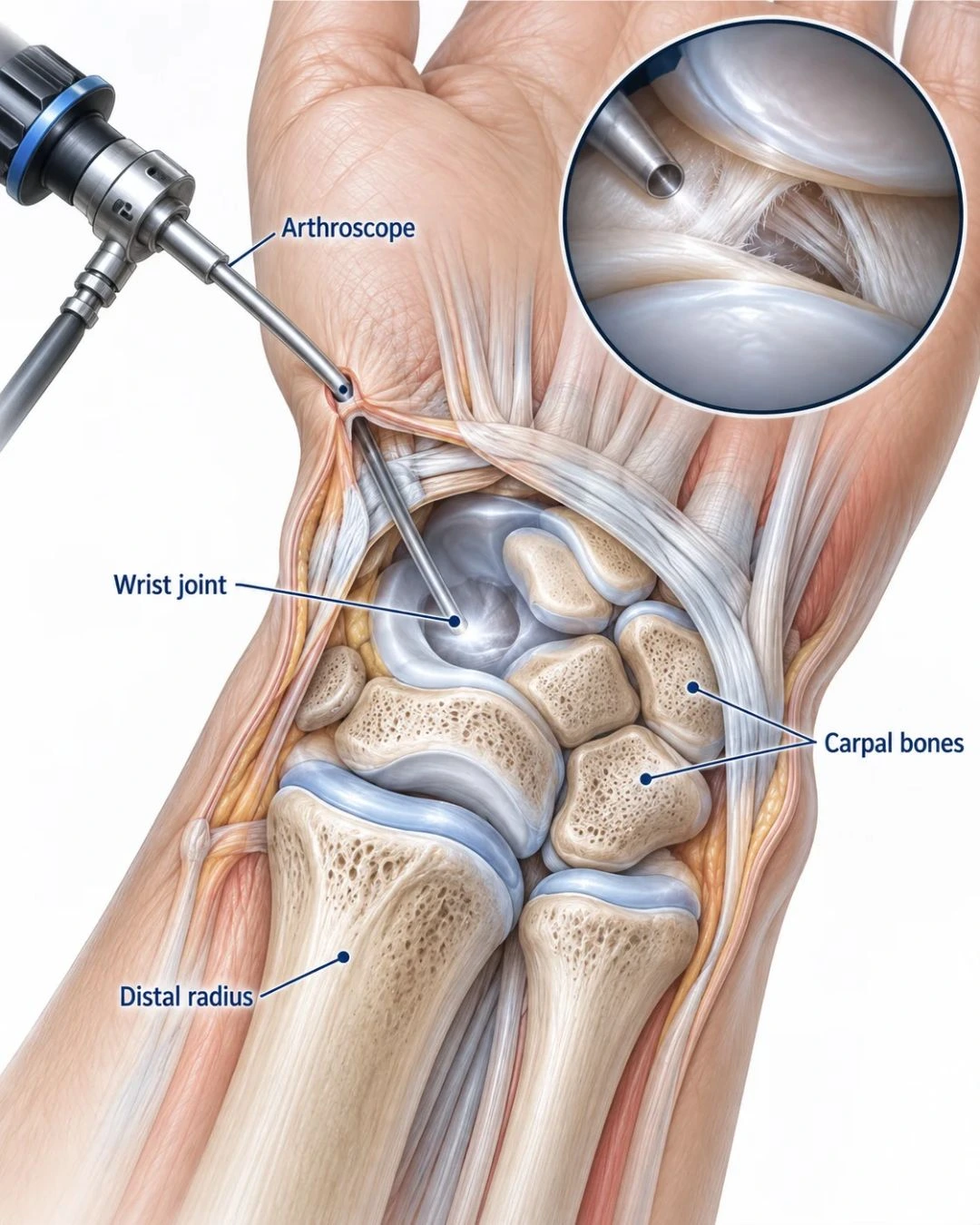
The wrist is a compact joint made of eight small carpal bones, held together by ligaments, with a cartilage cushion called the TFCC on the little-finger side. Injuries inside it do not always show clearly on an X-ray or MRI.
In wrist arthroscopy, the surgeon makes two or more small cuts, called portals, on the back of the wrist. A thin camera called an arthroscope is passed through one portal and shows a magnified view of the joint on a screen. Fine instruments pass through the other portals.
The procedure can be diagnostic, therapeutic or both:
If a treatable problem is found during a diagnostic arthroscopy, it can often be treated in the same sitting, provided this was discussed and agreed with you beforehand. For a general overview of keyhole surgery in other joints, see our page on arthroscopy across different joints.
Dr. Bipin Ghanghurde has 18 years of experience, and his practice is focused on the hand, wrist and peripheral nerves. After his MS in Orthopaedics, he completed fellowship training in hand and microsurgery at Ogori Daiichi General Hospital in Japan and further hand surgery training at University Hospital Ghent in Belgium. He holds the European Diploma in Hand Surgery.
Wrist arthroscopy is one of the procedures he performs, alongside hand and wrist trauma surgery, tendon repair and transfer, nerve surgery and microsurgical reconstruction. That range matters for wrist problems: deciding between debridement, repair, open surgery or no surgery at all needs a surgeon who uses each of these approaches.
He is a member of the Indian Society for Surgery of the Hand, the American Society for Surgery of the Hand and the Bombay Orthopaedic Society.

Dr. Kiran Ladkat specialises in hand, wrist, peripheral nerve and microvascular surgery. He completed fellowship training in hand and reconstructive microsurgery at Ganga Hospital, Coimbatore, and the National University Hospital, Singapore. Alongside wrist arthroscopy, his practice covers ligament injuries of the hand and wrist, hand and wrist trauma, nerve disorders and congenital hand conditions.

Arthroscopy is considered when there is a specific problem inside the wrist that it can treat or clarify, usually after non-surgical care has been tried. Pain or clicking alone does not mean you need surgery. The decision rests on your examination, your scans, how stable the wrist is and what you need your wrist to do.
The TFCC is a group of ligaments and cartilage on the little-finger (ulnar) side of the wrist. It cushions the joint and helps stabilise the distal radioulnar joint (DRUJ), where the two forearm bones meet near the wrist.
TFCC tears can follow a fall on an outstretched hand or a twisting injury. They can also develop gradually with age and repeated loading. Typical complaints are pain on the little-finger side, clicking, and pain when gripping or turning the forearm, for example turning a key or opening a jar. Arthroscopy shows exactly where and how the TFCC is torn, which decides between two different procedures:
Ligaments between the small wrist bones can tear in a fall, most importantly the scapholunate ligament (between the scaphoid and lunate) and the lunotriquetral ligament. Arthroscopy shows how badly the ligament is torn and how much the bones move, which X-rays and MRI can underestimate.Some partial tears can be treated arthroscopically. Complete or long-standing tears often need open repair or reconstruction, and the arthroscopy findings help plan that surgery.
The steps are broadly the same for most patients; what happens inside the joint depends on what is found.
For many wrist problems, the first step is not surgery. Arthroscopy is one option among several, and the right choice depends on the diagnosis rather than the symptoms.
Non-surgical treatment is often tried first. Many TFCC tears, particularly those where the DRUJ remains stable, settle with a period in a splint or cast, a change in activities and guided hand therapy. Sprains and partial ligament injuries are often managed the same way. A steroid injection may help in selected cases.
Another procedure may suit you better when:
Numbness or tingling in the thumb, index and middle fingers usually points to a nerve problem such as carpal tunnel syndrome rather than a problem inside the joint. An MRI report alone does not decide treatment. Small TFCC changes are common on scans of people with no wrist pain, especially after middle age. Your surgeon will match the scan to your examination before recommending anything.
You should not feel pain during the operation because of the anaesthesia. Afterwards, soreness and swelling are expected for a few days and are usually controlled with prescribed pain relief, keeping the hand raised and cold packs. A repair tends to ache for longer than a simple debridement.
There is no single recovery time for wrist arthroscopy. Small portals do not by themselves mean a quick recovery; the procedure performed inside the joint matters more.
In the first days, keep the hand raised, keep the dressing clean and dry, and move your fingers as instructed.
Hand therapy is part of recovery for most patients. Mangal Anand Hospital has hand therapy on site, coordinated with the surgical team, to restore movement, grip strength and a safe return to work and sport.
Complications after wrist arthroscopy are uncommon, but every operation carries some risk. Possible problems include:
The cost of wrist arthroscopy in Mumbai varies from patient to patient because it depends on what is done. The main factors are:
Mangal Anand Hospital is empanelled with major health insurers and third-party administrators. Cashless treatment is available subject to your policy terms and approval, and our insurance desk helps with pre-authorisation, documents and reimbursement.
It is a genuine operation, done in an operating theatre under anaesthesia, but it uses small cuts and many patients go home the same day. How major it feels depends on what is done inside the joint: a diagnostic look or debridement is a smaller undertaking than a TFCC or ligament repair, which needs weeks of protection afterwards.
Operating time depends on the procedure: a diagnostic arthroscopy or debridement is shorter than a repair or fracture fixation. Allow extra time at the hospital for preparation, anaesthesia and recovery. Many patients go home the same day; your surgeon will advise if an overnight stay is better for you.
Many TFCC tears improve without surgery, particularly when the wrist joint remains stable. Treatment usually involves a period in a splint or cast, activity changes and hand therapy. Surgery is considered if symptoms persist despite this, or earlier when the tear has made the distal radioulnar joint unstable.
The portals are small, usually less than a centimetre each, so the scars are small. They are often pink or slightly tender at first and usually fade over several months. If arthroscopy is combined with open surgery or fracture fixation, there will also be a longer incision.
Not always. X-rays are usually the first test, and an MRI is often requested when a TFCC, ligament or cartilage injury is suspected. Because MRI can miss or overcall some wrist injuries, your surgeon interprets it alongside your examination. If you need one, MRI is available within the hospital. Bring any scans you already have to your consultation.
It depends on your job and the procedure. Desk work may resume within days to a couple of weeks after a simple arthroscopy, while manual work usually takes longer, especially after a repair. Drive only once you can grip and control the steering wheel safely without a splint and are not taking medicine that causes drowsiness.
If wrist pain, clicking or weakness has lasted more than a few weeks, or began after a fall and has not settled, an assessment can find the cause. Your consultation is to establish what is wrong and discuss your options, including whether wrist arthroscopy is appropriate for you. Please bring any X-rays, MRI scans and reports you already have.
Mangal Anand Hospital, 48 Swastik Park, Sion–Trombay Road, Chembur, Mumbai 400071
Call +91 70212 18182 or book an appointment online; our team will contact you to confirm a time with the specialist.
Mangal Anand Hospital provides evaluation and treatment for a range of hand and wrist conditions. Depending on the diagnosis, treatment may include:
Mangal Anand Hospital is located in Chembur, Mumbai, and is conveniently accessible for patients from Ghatkopar, Kurla, Tilak Nagar, Sion, Wadala, Govandi, Deonar and Navi Mumbai.