


A small cut, blister or corn may seem minor. But when you have diabetes (sugar), it can turn into a foot ulcer or infection faster than you expect. Diabetes can reduce feeling in the feet and slow down healing, so many problems go unnoticed until they become serious.
The Diabetic Foot Clinic at Mangal Anand Hospital, Chembur, Mumbai, checks, treats and protects feet affected by diabetes. Here, foot and ankle surgeons, an interventional radiologist and a diabetologist work as one team to treat diabetic foot ulcers, non-healing wounds, foot infections, poor circulation, numbness, corns and calluses, Charcot foot and foot deformities.
We do not just dress the wound. We find out why it formed, whether it is pressure, nerve damage, poor blood flow or infection, and treat that cause so the wound can heal and stay healed.

A diabetic foot clinic is a specialist service for people with diabetes who have, or are at risk of, foot problems. It does two jobs:
A general dressing or a course of antibiotics may not be enough for a diabetic foot wound. Healing depends on pressure, blood supply, nerve health and infection control, so all of these are checked together.
Who Should Visit a Diabetic Foot Clinic?
You do not have to wait for a large or painful wound. Book a diabetic foot check if you have diabetes and:
People who have had a diabetic foot ulcer before need regular foot checks because the risk of another ulcer is higher.
Dr. Dhrumin Sangoi is an orthopaedic surgeon who works exclusively on the foot and ankle, with 17 years of overall experience. His areas of work include limb salvage and reconstruction, foot and ankle surgery, arthroscopy and sports medicine, and total ankle replacement. Dr. Dhrumin Sangoi completed his Diabetic and Charcot Foot fellowship at King's College Hospital, London.
In the Diabetic Foot Clinic, Dr. Dhrumin Sangoi treats diabetic foot ulcers, Charcot foot, foot deformities and infections that may need surgery or reconstruction to save the foot.

Dr. Shyam Thakkar is a fellowship-trained foot and ankle surgeon whose work focuses on reconstruction, arthroscopic surgery and limb salvage. His experience includes more than 500 diabetic and Charcot foot reconstructions and limb salvage procedures aimed at preventing amputation.
Dr. Shyam Thakkar completed his MS in Orthopaedics at Topiwala National Medical College and B.Y.L. Nair Hospital, Mumbai. His foot and ankle fellowship training was at the Orthopaedic Foot and Ankle Center, Columbus, Ohio (USA) and Sunshine Global Hospitals, with further fellowship training in arthroscopy and sports medicine at SportsMed, Mumbai, and training in Bologna, Italy. Dr. Shyam Thakkar has served as Assistant Professor of Orthopaedic Surgery (Foot & Ankle) at Bharati Vidyapeeth University, is a member of the Indian Foot & Ankle Society (IFAS) and is a co-author of the Video Atlas of Foot & Ankle Surgery.

Dr. Amit Sahu has more than 12 years of experience in interventional radiology and has performed thousands of endovascular procedures. For diabetic foot patients at Mangal Anand Hospital, Dr. Amit Sahu performs angioplasty and stenting to open narrowed or blocked leg arteries, so that more blood reaches the foot and wounds can heal.
Dr. Amit Sahu trained in vascular and interventional radiology at Seth GS Medical College & KEM Hospital, Mumbai, at Kokilaben Dhirubhai Ambani Hospital, Mumbai, and in peripheral and neuro-interventions at Johns Hopkins Hospital, Baltimore (USA). Dr. Amit Sahu is a member of the Indian Society of Vascular & Interventional Radiology (ISVIR) and the Society of Interventional Radiology (SIR).

Dr. Harsh Shah has more than 15 years of experience in diabetology and general medicine. Dr. Harsh Shah completed his MBBS at Terna Medical College, Navi Mumbai, and a Postgraduate Diploma in Diabetology from Annamalai University. In the Diabetic Foot Clinic, Dr. Harsh Shah manages blood sugar, medicines and long-term diabetes care. Good sugar control helps wounds heal and helps the body fight infection, so this is a core part of every diabetic foot treatment plan.

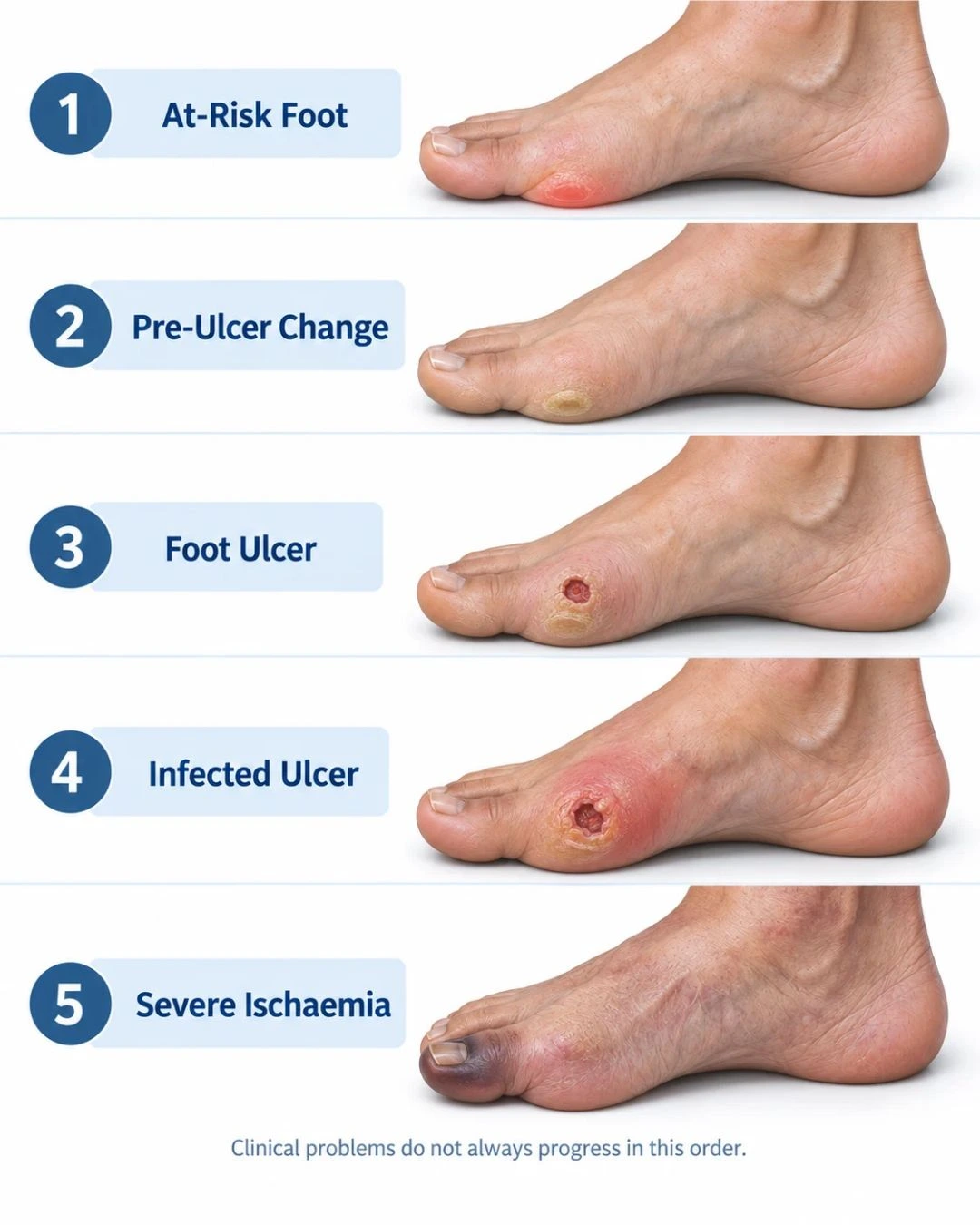
Diabetic foot problems usually develop because of several changes happening together:

Some people feel burning or pain. Others lose so much feeling that a serious wound causes little or no pain. No pain does not mean no problem.
Watch for:
Go to a hospital the same day if a diabetic foot wound has:
A foot that suddenly becomes hot, red and swollen without an injury also needs urgent assessment. In a person with neuropathy, this can be an early sign of Charcot foot, even if there is little pain.
A diabetic foot ulcer is an open sore, commonly on the ball of the foot, heel or toes. It usually starts at a pressure point that you may not feel because of numbness. Early-stage diabetic foot ulcers can look like a small blister or a crack under a callus, which is why they are easy to ignore.
If a wound has not improved in a few weeks despite dressings, something is stopping it from healing. Common reasons are continued pressure, poor blood supply, hidden infection or dead tissue. These need to be found and treated.
Infection can stay in the skin or spread to tendons, joints and bone (osteomyelitis). Gangrene means tissue has died due to infection or very poor blood flow. Both need urgent treatment to control the infection and save as much of the foot as possible.
In diabetes, a thick callus is a warning sign, not just a cosmetic problem. Damage can develop under it without pain. Cracked heels, fungal infections and ingrown toenails can also let infection in.
Neuropathy can cause burning, tingling, pins and needles or complete loss of feeling. Treatment helps manage symptoms, and foot protection prevents injuries that you cannot feel.
Charcot foot is a serious complication of neuropathy in which the bones and joints of the foot weaken and collapse. It often begins as a warm, red, swollen foot with little pain, and is sometimes mistaken for a sprain, gout or infection. Without early treatment, the arch can collapse into a "rocker-bottom" shape that creates new pressure points and ulcers. Early diagnosis is important to protect the foot's shape.
Claw toes, hammer toes, bunions and prominent bones under the foot shift weight onto small areas of skin. In a numb foot, these become common sites for repeated ulcers.
Cold feet, colour changes, calf pain on walking or wounds that heal very slowly may point to reduced blood flow. Circulation is checked in every diabetic foot assessment because blood supply decides whether a wound can heal.
There is no single "5-stage" system for every diabetic foot problem. Doctors commonly use the Wagner classification, which has six grades, from 0 to 5:
Grade 0 : High-risk foot, no open wound (for example, callus or deformity)
Grade 1 : Superficial ulcer affecting the skin
Grade 2: Deeper ulcer reaching tendon, joint or deeper tissue
Grade 3: Deep ulcer with abscess or bone infection
Grade 4: Gangrene of part of the foot, such as the toes or forefoot
Grade 5: Gangrene of the whole foot
Other systems are also used to grade infection and blood supply. What matters most is this: a small-looking wound can still be deep or infected.
Your first visit focuses on finding the cause of the problem. A typical assessment includes:
At the end of the visit, you get a clear explanation of the problem and a treatment plan.
What to bring to your appointment
Your treatment depends on what the assessment finds. A pressure ulcer with good blood flow needs a very different plan from an infected wound or a Charcot foot.
Dressings are chosen based on the wound's depth, moisture and condition. No single dressing suits every ulcer. The wound is measured at each visit so we can see whether it is healing.
Debridement means removing callus, dead tissue and debris from the wound. This helps healthy tissue grow and lets the doctor see the true depth of the ulcer. It ranges from simple callus removal in the clinic to surgical cleaning of infected tissue in the operation theatre.
Antibiotics are given when there are signs of infection, not for every wound. The choice depends on how deep and severe the infection is, and may be guided by a wound culture. An abscess or dead tissue may need surgical drainage along with antibiotics.
This is one of the most important parts of healing a diabetic foot ulcer, and one of the most commonly missed. If you keep walking on an ulcer, it will not heal, even with daily dressings. Offloading options may include a total contact cast, a removable walker boot, or special footwear, chosen according to the location of your ulcer and your mobility.
After healing, the right footwear helps prevent the ulcer from coming back. Shoes and custom insoles are chosen according to your foot shape and pressure points. A shoe labelled "diabetic footwear" in a shop is not automatically right for your foot.
Active Charcot foot is treated by protecting the foot in a cast or knee-high boot until the swelling and bone activity settle. This helps prevent collapse. Later, custom footwear or a brace supports the foot. If the foot has become unstable or keeps developing ulcers, reconstructive surgery may be considered.
A wound cannot heal without enough blood supply. If tests show narrowed or blocked arteries in the leg, interventional radiologist Dr. Amit Sahu can perform angioplasty at Mangal Anand Hospital, with or without a stent, to open the artery. It is a minimally invasive procedure done through a small puncture, usually in the groin, rather than open surgery. Not every patient with reduced circulation needs angioplasty. The decision depends on how severe the blockage is, the wound, and your overall health. When it is needed, it is planned together with your foot treatment, often before or alongside wound surgery.
High blood sugar slows healing and weakens the body's ability to fight infection. Diabetologist Dr. Harsh Shah reviews your sugar levels, HbA1c and medicines, and adjusts treatment, including insulin when needed, as part of your foot care plan.
Surgery is needed only for specific problems, such as:
The aim of surgery is limb salvage: saving as much of the foot as possible and keeping you walking. When part of a toe or foot cannot be saved, the surgery is planned to leave a stable foot that fits into footwear.
Yes. Many diabetic foot ulcers heal without an operation when:
Non-surgical treatment includes wound care, debridement, offloading, footwear and infection control. If the wound does not improve, or infection, deformity or blood flow becomes a concern, the plan is reviewed.
Rather than looking only at rankings, ask:
Many diabetic foot ulcers can be prevented with simple daily habits and regular foot checks.
Do:
Don't:
A healed ulcer does not mean the risk has gone. If the nerve damage, pressure or deformity that caused it is still present, the ulcer can return. Prescribed footwear, custom insoles, treatment of recurring calluses and regular follow-up visits help keep the foot healthy.
The right doctor depends on the cause. A foot and ankle surgeon treats ulcers, deformities, Charcot foot, bone infection and problems that need surgery. An interventional radiologist treats blocked leg arteries with angioplasty, and a diabetologist manages blood sugar. Complex cases do best when all three work together.
The Diabetic Foot Clinic at Mangal Anand Hospital, Chembur, is run by foot and ankle surgeons Dr. Dhrumin Sangoi and Dr. Shyam Thakkar, interventional radiologist Dr. Amit Sahu and diabetologist Dr. Harsh Shah. Together they cover wound and foot surgery, blood flow and sugar control.
The doctor checks your skin, nails, foot shape and any wound, tests sensation with a monofilament, checks the pulses in your feet and reviews your footwear. Tests such as X-ray, MRI, Doppler or blood tests are advised only if needed. You then receive a treatment and follow-up plan.
The commonly used Wagner classification actually has six grades, numbered 0 to 5. Grade 0 is a high-risk foot without a wound. Grades 1 to 3 describe ulcers of increasing depth and infection. Grades 4 and 5 describe gangrene of part of the foot or the whole foot.
Yes, many diabetic foot ulcers heal with the right treatment. Healing depends on the ulcer's depth, blood supply, infection, pressure on the wound and sugar control. Taking pressure off the ulcer (offloading) is one of the most important parts of treatment.
There is no fixed time. A small, shallow ulcer with good blood flow may heal in a few weeks, while a deep or infected ulcer can take months. If a wound shows no improvement after a few weeks of proper care, the cause needs to be reassessed.
Seek same-day care if the wound has spreading redness or swelling, pus or a bad smell, black or dusky skin, or if you have fever with a foot wound. Mangal Anand Hospital's emergency department is open 24x7.
Diabetes does not mean you will need an amputation. The risk rises when nerve damage, ulcers, severe infection and poor circulation occur together and are not treated in time. Early treatment of wounds and regular foot checks can significantly reduce this risk.
Everyone with diabetes should have a complete foot check at least once a year. If you have numbness, poor circulation, a foot deformity or a previous ulcer, you will need more frequent checks, as advised by your doctor.
Choose closed, well-fitting shoes with enough toe room, soft lining and no rough inner seams. Avoid tight shoes, high heels and thin-strap slippers. If you have numbness, deformity or a past ulcer, you may need custom-made footwear or insoles based on your foot's pressure points.
Mangal Anand Hospital is located in Chembur, Mumbai, and is conveniently accessible for patients from Ghatkopar, Kurla, Tilak Nagar, Sion, Wadala, Govandi, Deonar and Navi Mumbai.